
Are Solid State Batteries Better Than Lithium Ion?
Compare solid state battery vs lithium ion across safety, cost, range, and availability so you can make a smarter choice. Read more.
If you are comparing solid state battery vs lithium ion, the practical answer is not “newer is better.” Lithium-ion is still the safer choice for buying an EV, laptop, phone, power tool, or home battery today because it is proven and widely supported. Solid-state is the technology to watch if you care about future premium EVs, lighter packs, and possible safety gains, but it is not yet the default option for real-world buyers.
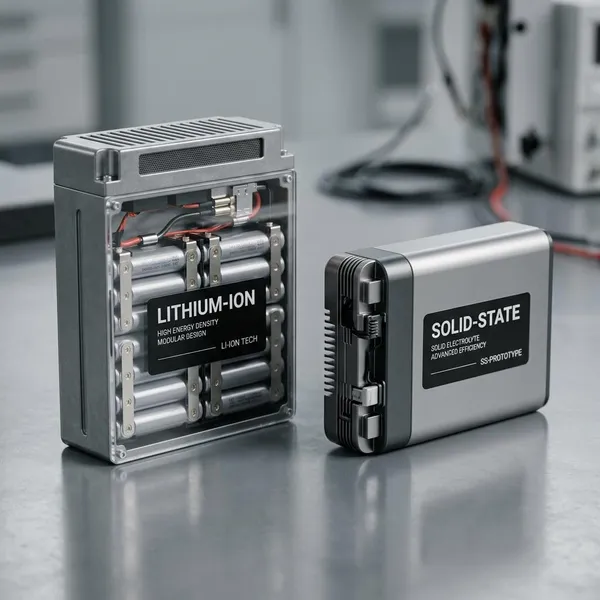
Two Battery Products to Know
Real products make the comparison easier. Panasonic’s 4680 cell shows how far mainstream lithium-ion can still improve, while QuantumScape’s QSE-5 shows where solid-state battery development is heading for future vehicles.
| Comparison Item | Panasonic 4680 Scaled upgrade of conventional Li-ion cells | QuantumScape QSE-5 Next-generation solid-state lithium-metal cell |
|---|---|---|
| Battery Type | Liquid-electrolyte Li-ion | Solid-state lithium-metal |
| Electrolyte | Liquid electrolyte | Ceramic solid electrolyte |
| Anode Structure | Conventional anode | Anode-free design |
| Cell Format | 4680 cylindrical cell | Multilayer pouch-style cell |
| Core Advantage | Manufacturing scalability | Energy density and safety potential |
| Mass Production Maturity | Near mass-production readiness | Still scaling production process |
| Commercialization Progress | Targeted for EV supply | Customer samples and validation |
| Main Limitations | Incremental performance gains | Unproven high-volume manufacturing |
Lithium-Ion Reference Panasonic 4680 Cell
- Cell size: Panasonic 4680 is a large cylindrical cell measuring about 46 mm in diameter and 80 mm in height. Compared with 2170 or 1865 cells, it reduces the number of cells needed in an EV pack but requires stronger thermal and structural management.
- Technology route: It follows Panasonic’s high-energy cylindrical lithium-ion route, using a nickel-rich chemistry and a tabless-style design to improve current flow. This positions it for higher energy and power output rather than low-cost entry-level applications.
- Core advantages: Its larger format can improve pack-level efficiency by reducing cell count, interconnects, and assembly complexity. For EV makers, this may support better range, power delivery, and manufacturing simplification when pack design is optimized around the format.
- Main limitations: The larger cell size makes heat dissipation and manufacturing yield more challenging than smaller cylindrical cells. It also requires vehicle platforms and battery packs specifically designed for 4680 integration, limiting drop-in replacement potential.
Solid-State Technology to Watch QuantumScape QSE-5
QuantumScape QSE-5 is a product-intent solid-state lithium-metal battery cell under development and customer validation; it should not be described as already commercially available or installed in production vehicles.
- Product positioning: QSE-5 is positioned as QuantumScape’s first EV-oriented, product-intent solid-state cell, aimed at automaker qualification rather than retail sale. Status: R&D/customer-sample stage, not a mass-market product.
- Cell structure: The cell uses an anode-free lithium-metal architecture with a solid ceramic separator, meaning lithium metal forms during charging instead of using a conventional graphite or silicon anode. Status: disclosed technology platform, still being scaled for manufacturable automotive cells.
- Fast charge and cycle behavior: QuantumScape has reported prototype fast-charging capability around 10%–80% in under 15 minutes, and has published multilayer prototype cycling results in the hundreds to 1,000+ cycle range depending on test protocol. Status: measured prototype results, while automotive lifetime validation remains ongoing.
- Safety advantages: The nonflammable ceramic separator and anode-free design are intended to improve resistance to dendrite-related failure and reduce anode-side combustible material. Status: material/cell-level safety advantage; full pack-level abuse testing and OEM qualification are still required.
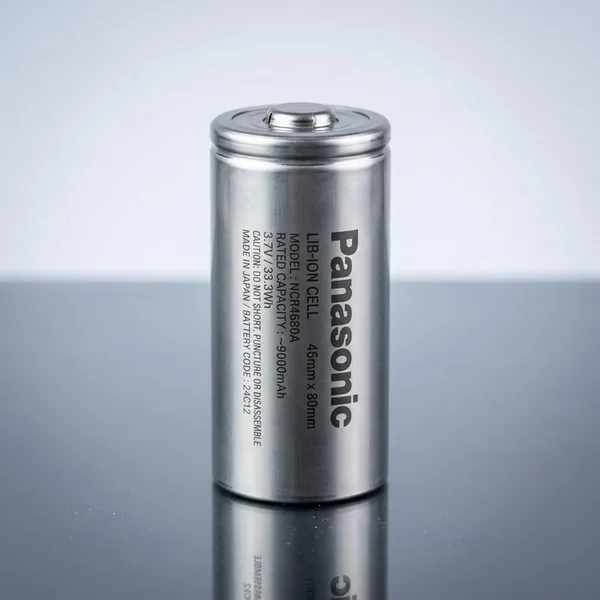
Panasonic 4680 Lithium-Ion Cell
A lithium-ion battery moves lithium ions between an anode and a cathode through an electrolyte. That basic idea has been refined for decades, which is why lithium-ion still dominates EVs, phones, laptops, cordless tools, and home storage.
Cylindrical lithium-ion design
A cylindrical cell uses rolled internal layers inside a metal can. This format is familiar to manufacturers, mechanically sturdy, and relatively predictable for cooling and pack design.
The larger 4680 format can reduce the number of individual cells needed in a pack. That does not automatically make every EV better, but it can help automakers reduce complexity where the vehicle platform is designed around it.
Manufacturing readiness and scalability
- Check availability first: if a vehicle or device is on sale now, it is almost certainly built around lithium-ion.
- Check support second: warranty terms, service networks, diagnostics, and replacement pathways are usually clearer.
- Check chemistry claims last: a promising battery is less useful if the product around it is not mature.
Strengths and limitations for EVs
Lithium-ion is still the best fit for mainstream EVs because it gives a workable balance of range, charging speed, cost, supply, and durability. If your use is a normal commute, school run, weekly shopping, and occasional highway trip, current lithium-ion EVs already cover that job well when the car’s range and charging network fit your routine.
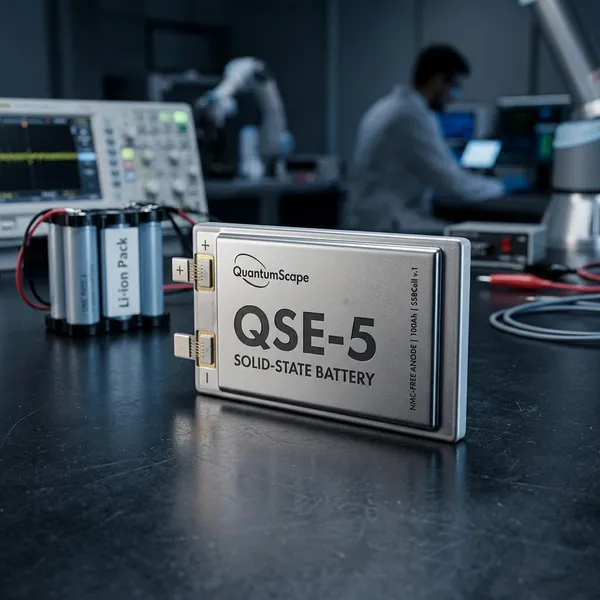
QuantumScape QSE-5 Solid-State Cell
A solid-state battery replaces the liquid or gel electrolyte used in conventional lithium-ion cells with a solid electrolyte or solid separator system. The goal is to improve energy density, safety characteristics, and packaging options, especially in vehicles where weight and space matter.
Anode-free solid-state architecture
QuantumScape’s anode-free approach is designed to remove the conventional graphite anode at the start of the cell’s life and form lithium metal during charging. In simple terms, the design aims to save internal space and raise energy density.
- Premium EVs: more range without simply making the pack larger.
- Performance cars: lower battery weight could help efficiency and handling.
- Compact platforms: better packaging may free space for cabin or design priorities.
B-sample testing and automotive focus
B-sample testing suggests QSE-5 has moved beyond an early research idea, but it should not be confused with mass-market readiness. Automakers still need long validation cycles before they trust a cell in vehicles that customers will keep for years.
Scale-up and commercialization challenges
- Material handling must be repeatable: small internal defects can matter more at automotive scale.
- Interfaces must stay stable: the cell has to perform through many charge cycles, not only in short tests.
- Costs must fall: premium buyers may accept higher prices, but mainstream buyers usually will not.
- Vehicle integration must be proven: charging, cooling, crash safety, and diagnostics all need validation.
Where Each Battery Technology Fits Best
The better battery depends on the product and the buying timeline. Lithium-ion wins when you need something available, affordable, and well supported now. Solid-state becomes more interesting when performance gains are worth paying for and when early supply limits are acceptable.
Lithium-ion for current EVs
For current EV shoppers, lithium-ion is the practical default. It has known charging behavior, established safety systems, and enough real-world data for automakers to set warranties and improve software.
Lithium-ion for electronics and energy storage
Phones, laptops, tablets, power tools, home batteries, and grid storage still suit lithium-ion very well. These products value cost, supply stability, predictable performance, and proven safety engineering more than experimental energy density gains.
Solid-state for future premium mobility
Solid-state is most likely to appear first where its benefits can justify higher prices. Premium EVs, performance models, and advanced mobility platforms are better early targets than budget cars.
Solid-state for specialized applications
Specialized fields may adopt solid-state earlier than the mass market if the performance gain is important enough. Aerospace, defense, robotics, medical equipment, and advanced industrial systems may accept higher battery costs when lower weight, compact design, or added safety margin has real value.
Conclusion
Lithium-ion is still the better answer for most real purchases because it is available, scalable, and supported across EVs, electronics, and storage. Solid-state has the more exciting upside, especially for premium mobility and specialized uses, but it still has to prove cost, durability, and production scale. If you need a battery-powered product now, judge the actual product and warranty first; if you are tracking the next jump in battery performance, solid-state is worth watching without treating it as ready to replace everything.