
Which Solar Charger Keeps Your 12V Battery Ready?
Choose a solar battery trickle charger maintainer for cars, RVs, boats, or bikes with clear sizing tips, key features, and setup advice.
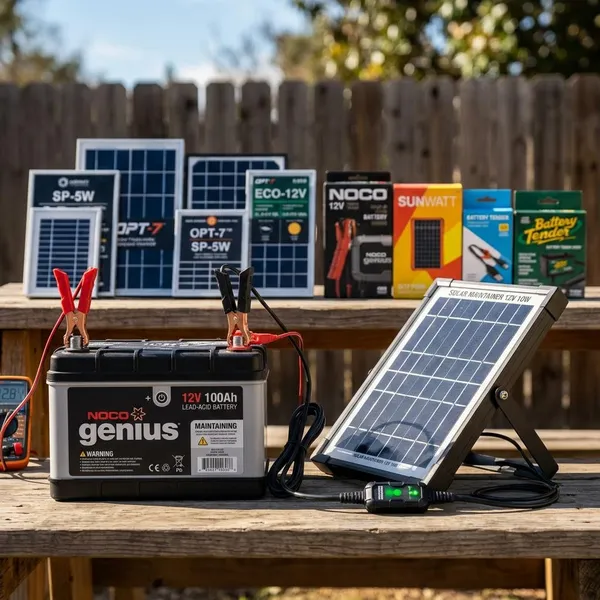
If you want the best solar battery trickle charger maintainer, start with the battery and parking situation, not the biggest panel you can find. Most car owners are safest with a regulated 10W to 20W 12V maintainer, while motorcycles can often use less and RVs or boats usually need more. The key is simple: enough solar output to cover small daily losses, plus a charge controller that makes long-term connection safer.
What is the best solar battery trickle charger maintainer?
The best choice is usually a 12V solar maintainer with enough wattage for the battery size, a proper charge controller, and connectors that fit how the vehicle is stored. For many everyday cars, SUVs, and light trucks, a 10W to 20W regulated unit is the most practical starting point.
Very small panels can work, but only when the battery is healthy, the standby drain is low, and the panel gets decent sunlight. Larger panels are useful when the vehicle has more electronics, sits for months, or is stored somewhere with weak winter sun or partial shade.
The best overall maintainer fits most 12V batteries
A good all-around maintainer is a 10W to 20W panel with a built-in or inline controller. That range gives most 12V car and light-truck batteries a useful maintenance charge without turning the setup into a larger solar system.
Look for battery clamps for temporary use, ring terminals for long-term storage, and an SAE quick-connect if you plan to plug and unplug it often. If the vehicle sits for three or four weeks at a time, this category is usually a better buy than a tiny dashboard panel.
The best small maintainer fits motorcycles and ATVs
For motorcycles, scooters, ATVs, and lawn equipment, a 5W to 10W maintainer is often enough when the battery is in good shape and the machine has little standby draw. The practical advantage is placement: a small panel is easier to mount on a shed wall, fence, shelf, or sunny garage window area.
- Good fit: a seasonal motorcycle stored with a healthy AGM battery.
- Use caution: a bike with an alarm, tracker, heated accessory wiring, or a weak older battery.
- Not the right job: reviving a battery that is already deeply discharged.
How does a solar battery maintainer work?
A solar battery maintainer turns sunlight into a small charging current for a 12V battery. It is meant to offset self-discharge and small parasitic loads, not to act like a fast charger for a dead battery.
Solar panels generate charging power
The panel creates direct current from sunlight. Rated wattage is measured in ideal conditions, so real output is often lower because of shade, clouds, heat, dirt, glass, and poor angle.
This is why a little extra capacity can be useful. A 10W panel in open sun may maintain a car battery well, while the same panel behind tinted glass or under trees may only slow the discharge.
Charge controllers manage battery charging
The controller regulates the power going into the battery. It helps reduce the risk of overcharging and makes the maintainer more suitable for being left connected for weeks or months.
An unregulated low-output panel may be fine for brief, supervised use in mild conditions, but it is not the best choice for long storage. If you are maintaining an AGM, gel, or expensive marine battery, buy a model that clearly supports that battery type.
Batteries receive small maintenance charges
The battery receives a slow top-up charge that helps keep it near a healthy state of charge. That is useful because many lead-acid batteries age faster when they sit partly discharged for long periods.
A maintainer cannot repair a sulfated, shorted, or worn-out battery. If a battery will not hold charge after being properly charged, test the battery before blaming the solar panel.
When should you use a solar battery maintainer?
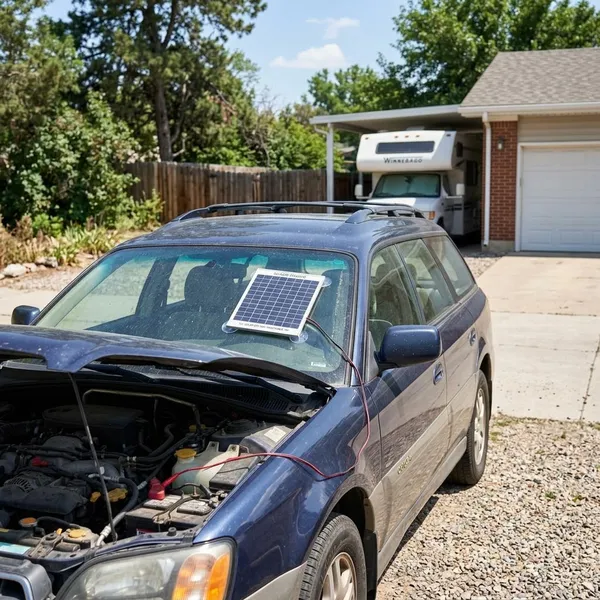
Use a solar maintainer when a healthy battery sits long enough to lose charge and a wall outlet is not convenient. It is especially useful for seasonal vehicles, second cars, trailers, boats, motorcycles, and equipment stored outdoors.
It is less useful for a vehicle that is driven often on longer trips, because the alternator is already doing the maintenance work. It is also not the first fix for a battery that is already failing.
It supports vehicles during long storage
Long storage is one of the clearest reasons to use one. A convertible parked all winter, a motorcycle stored until spring, or a lawn tractor left in a shed can lose charge even if nobody touches it.
For storage that lasts months rather than weeks, choose a regulated maintainer and check the setup now and then. Snow on the panel, a loose clamp, or a shaded parking spot can quietly stop the system from doing much.
It helps vehicles parked without power outlets
Solar makes sense when the vehicle is in a driveway, marina, field, storage lot, barn, or shared parking area where plug-in charging is awkward or unsafe. You avoid extension cords and do not have to remove the battery just to keep it topped up.
The deal-breaker is sunlight. If the panel spends most of the day in shade, behind heavy tint, or under a cover, a plug-in maintainer or battery removal may be the more reliable option.
How do you choose a solar battery maintainer?
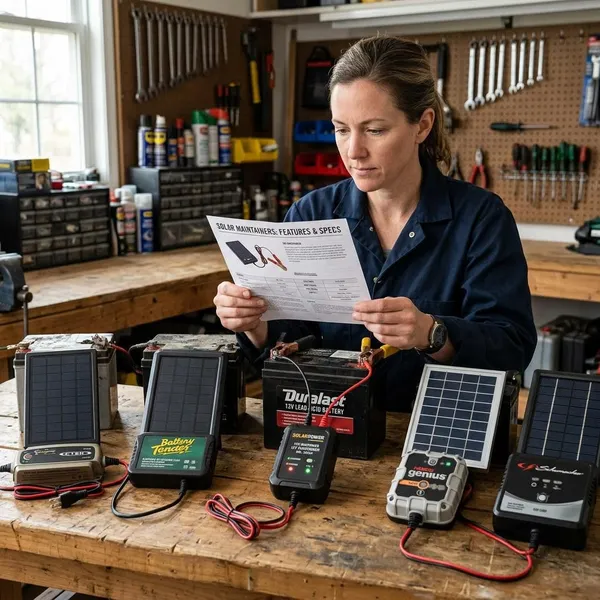
Choose by matching four things: wattage, battery chemistry, connectors, and weather exposure. If you only compare advertised watts, you may miss the details that decide whether the maintainer is easy and safe to use.
| Storage situation | Practical starting point | What to watch |
|---|---|---|
| Motorcycle or ATV | 5W to 10W regulated maintainer | AGM compatibility and quick disconnects |
| Car, SUV, or light truck | 10W to 20W regulated maintainer | Parasitic drain, windshield loss, connector access |
| RV, boat, tractor, or large battery | 20W to 30W or higher | Controller quality, weatherproofing, standby loads |
Match wattage with battery size
Wattage should cover both the battery’s natural self-discharge and the vehicle’s standby draw. For many car batteries, 10W to 20W is a sensible real-world range; 5W may work only in easy conditions with strong sun and very low drain.
Size up if the panel must sit behind a windshield, the vehicle sits through winter, or you already know the battery gets weak between uses. A larger panel does not fix every problem, but it gives more margin when sunlight is not ideal.
Match charging type with battery chemistry
Check whether your battery is flooded lead-acid, AGM, gel, or another type before buying. The maintainer should state that it supports your battery chemistry, especially for AGM and gel batteries that may be more sensitive to charging voltage.
If the product page is vague, look for the manual or choose a clearer model. Guessing is not worth it when the battery costs much more than the maintainer.
Match connectors with your setup
Battery clamps are useful for temporary connection, but ring terminals are better for a vehicle stored regularly. Once installed, you can connect the panel with a quick plug instead of opening covers or reaching awkward battery posts every time.
A 12V accessory plug can be convenient only if that socket stays live when the vehicle is off. Many modern vehicles shut those sockets down, so the panel may appear connected while delivering no charge to the battery.
What features make a solar maintainer better?
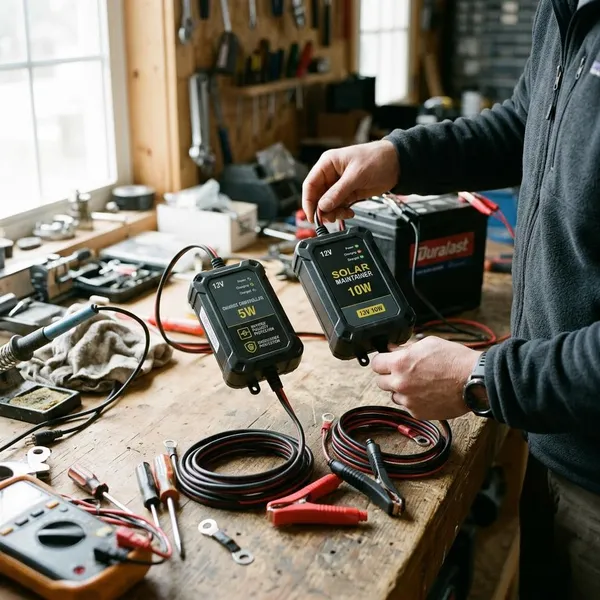
The best features are the ones that make the maintainer safer to leave connected and easier to confirm at a glance. A controller comes first, followed by safe wiring, usable connectors, good panel construction, and weatherproofing that matches the storage location.
Charge controllers prevent overcharging
A charge controller helps limit and manage voltage as the battery reaches a fuller state. That matters most when the maintainer is connected for long periods or used on a battery you do not want to risk, such as an AGM car battery or a marine battery bank.
If you are choosing between a bare panel and a regulated kit, the regulated kit is usually the better everyday choice.
Safety features protect battery connections
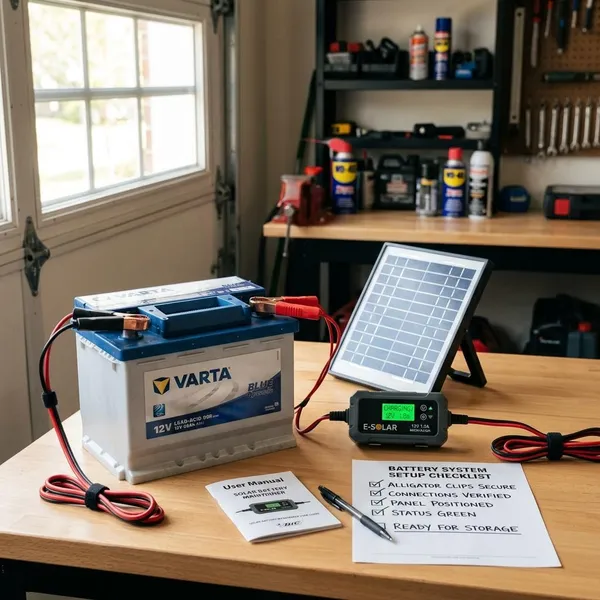
Useful safety features include reverse-polarity protection, an inline fuse, protected connectors, and clear status lights. These do not make the system foolproof, but they reduce the chance that a simple connection mistake damages wiring or leaves the battery unmaintained.
- Inline fuse: helps protect the circuit if wiring is pinched or shorted.
- Status light: quickly shows whether the panel and battery are connected.
- Covered connectors: reduce corrosion during outdoor storage.
Better panels improve charging performance
Better panels tend to produce more usable current in imperfect conditions. That can matter more than the label suggests, because a maintainer lives in the real world: low sun angles, dirty glass, cloudy days, awkward parking spots, and occasional shade.
If two panels have similar wattage, the one with better construction, stronger leads, and clearer performance information is usually the safer purchase.
Conclusion
The right maintainer is the one that covers your real standby drain, works with your battery chemistry, and can survive where the vehicle is parked. For most cars, a regulated 10W to 20W unit is the sensible middle ground; for motorcycles you can often go smaller, and for RVs, boats, or winter storage you should usually leave more solar margin. If the panel has good sun, a proper controller, and a connection you will actually keep using, it can prevent many dead-battery surprises without making storage complicated.