
Which Solar Fountain Pump Runs After Sunset?
Find the best solar water fountain pump with battery backup for bird baths, ponds, and fountains.
The best solar water fountain pump with battery backup depends on more than pump power. A reliable choice should fit your basin or pond size, available sunlight, required lift height, and how long you want the water to keep flowing when clouds move in or evening starts. Small bird baths usually work well with compact floating pumps, while ponds, shaded areas, and fountains with tubing often need a separate solar panel, a stronger pump, and a larger-capacity battery for steady performance.
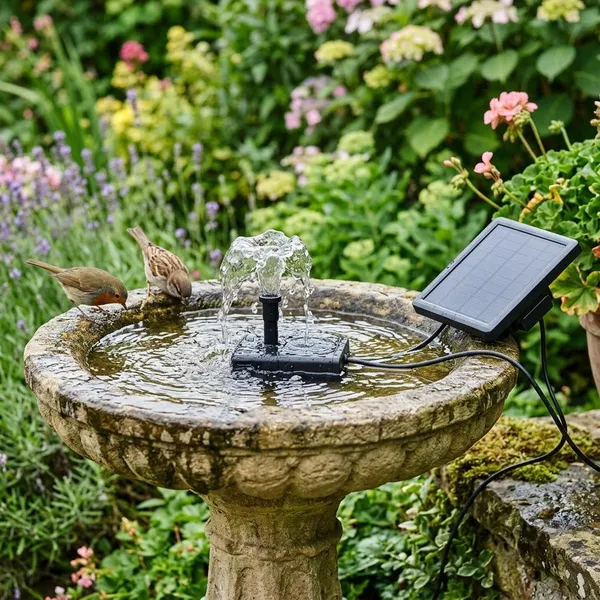
What is the best solar water fountain pump with battery backup?
A good solar fountain pump should do three things well: move the right amount of water, keep running through normal changes in sunlight, and stay easy to clean. If it only looks impressive in a product photo but splashes water out of the basin or stops every time a cloud passes, it is not the right fit.
Start with the water feature, not the pump listing. A shallow bird bath, a small pond, and a tiered decorative fountain all need different pump styles.
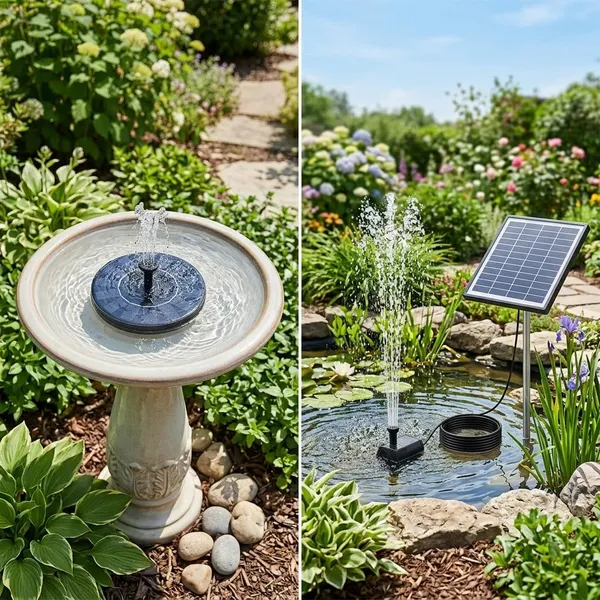
- Small sunny bird bath: choose a floating pump with gentle spray control.
- Larger pond or partly shaded feature: choose a separate panel pump so the panel can sit in better sun.
- Tiered fountain or statue: choose a high-lift pump with extra capacity above the minimum height.
Floating pumps fit small bird baths
Floating pumps are best for simple bird baths where the water surface gets direct sun. They are easy to use because the panel and pump sit together on the water, so there is no cable routing or separate panel placement to plan.
The main caution is splashing. If the spray is too tall for a shallow basin, the bird bath can lose water quickly on a warm day. For occasional backyard use, choose a floating model with interchangeable nozzles or adjustable flow rather than the tallest spray pattern.
Separate panel pumps fit larger ponds
Separate panel pumps make more sense when the water feature is larger, deeper, or not fully sunny. The pump stays in the water while the solar panel can be placed several feet away where it gets stronger light.
This setup is especially useful in a landscaped pond where plants or stones shade the water but a nearby patio edge or garden bed gets direct sun. It takes a little more setup, but it usually gives steadier charging and better water movement than an all-in-one floating unit.
High-lift pumps fit decorative fountains
A decorative fountain needs enough lift, not just enough flow. Lift height is the vertical distance the pump can push water, and it matters for tiered fountains, urn fountains, wall fountains, and statues with tubing.
If the outlet is close to the pump’s maximum lift rating, the real spray may be weak once tubing bends, nozzles, and filter buildup are added. For a permanent decorative fountain, leave a margin instead of buying a pump that barely meets the listed height.
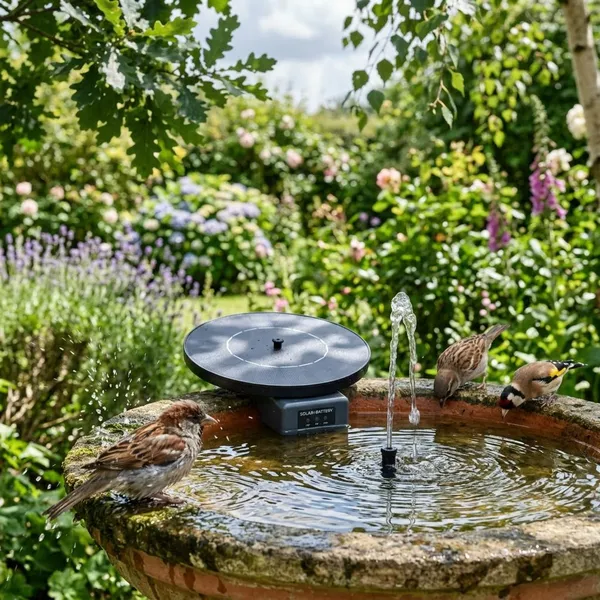
Why does battery backup matter?
Battery backup matters because garden sunlight is rarely steady all day. A direct solar pump may look fine at noon and then weaken when a cloud passes, a tree shadow moves, or the sun drops behind a fence.
A battery-backed pump stores extra energy during stronger sun and uses it when panel output dips. It will not make a shaded garden behave like a full-sun garden, but it can make a fountain feel much less stop-start in normal outdoor conditions.
It keeps water flowing during changing sunlight
With battery support, the pump does not have to shut off the moment sunlight drops. That gives you a smoother fountain display during passing clouds, shifting shadows, and late-afternoon light.
This is not only about looks. In a small basin, steadier movement helps avoid that stale, still-water appearance that can develop quickly in warm weather.
It improves performance in partial shade
Battery backup helps most when the panel still gets a few solid hours of direct sun. The battery can charge during those better hours and support the pump when the light becomes weaker.
It is less useful if the panel sits in heavy shade most of the day. In that case, the first fix is panel placement, not a bigger battery.
It extends operation beyond direct sunlight
A charged battery can keep some pumps running into late afternoon, early evening, or briefly after sunset. Runtime varies widely, so treat advertised claims carefully and compare battery capacity, pump wattage, and charging time together.
For a patio you mostly use after work, this feature can be the difference between a fountain you actually enjoy and one that only runs while nobody is outside.
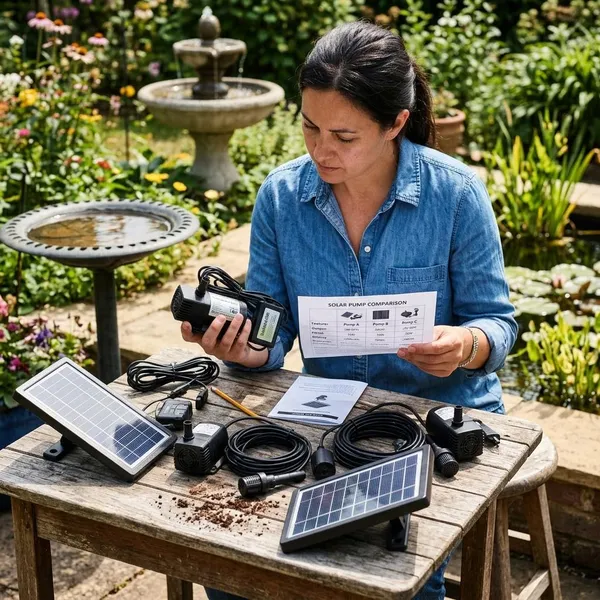
How do you choose a solar fountain pump?
Choose a solar fountain pump by checking four things in order: how much water you need to move, how high the water must rise, how much direct sun the panel will get, and how often you are willing to clean it. Those details matter more than a dramatic spray photo.
A quick pre-buy check is worth doing before comparing prices.
- Measure the vertical lift: from the pump position to the water outlet, not just the basin depth.
- Watch the sun: check the actual panel location in the morning, midday, and late afternoon.
- Think about water loss: small bird baths need gentle movement, not a high spray.
- Check cleaning access: removable filters and nozzles save frustration later.
Match flow rate with fountain size
Flow rate controls how much water the pump moves. A small bird bath usually needs a low, gentle spray or bubbler effect. Too much flow can empty the basin, scare birds away, and make the pump run dry if you do not refill it often.
For a larger basin or pond, low flow can look weak and may not circulate the water enough to be useful. Adjustable flow is a practical feature because it lets you reduce splashing in summer or increase movement when the basin can handle it.
Match lift height with water depth
Lift height is one of the easiest specs to underestimate. Water depth only tells you where the pump sits; lift height tells you how far the pump must push water upward.
For example, a pump sitting in a one-foot-deep basin may still need to push water two or three feet higher through tubing to reach a spout. Add bends, a nozzle, or a narrow tube, and the real output can drop. If your fountain has height, choose a pump rated comfortably above your actual lift.
Match battery capacity with runtime needs
Battery capacity should match when you want the fountain to run. If you only care about midday movement, a smaller backup battery may be fine. If you want evening operation, choose a model with a larger battery and a panel capable of charging it during the day.
Do not judge runtime from battery size alone. A stronger pump drains stored energy faster, especially with a tall spray or high lift. Look for estimated runtime on a full charge, charging time in good sun, and whether the pump can run while charging.
Match features with maintenance needs
The best features are the ones that reduce everyday hassle: intake filters, removable covers, dry-run protection, adjustable nozzles, and parts that can be rinsed without tools.
If your fountain sits under trees or birds use the bath daily, easy cleaning matters more than extra spray patterns. A pump that takes two minutes to rinse is more likely to keep working well through the season.
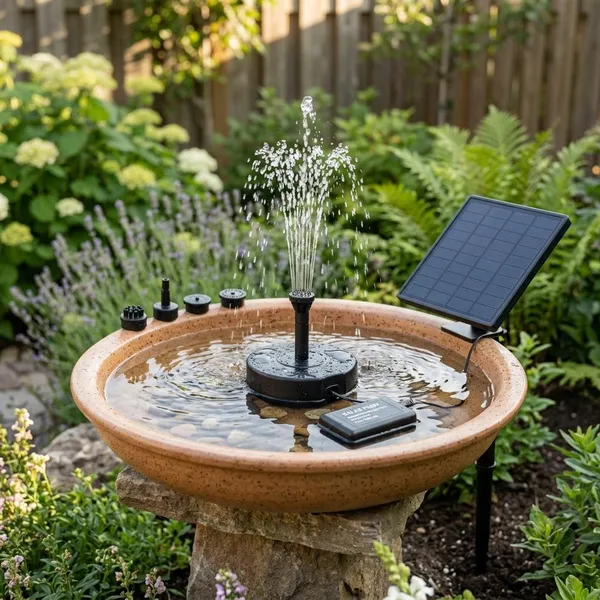
What features matter in a solar fountain pump?
The features that matter most are panel size, battery quality, pump strength, and durability. They decide whether the fountain runs steadily, charges well, and survives outdoor use without constant attention.
A useful way to compare models is to ask what problem each feature solves. Bigger is not always better. A large pump in a tiny bird bath can waste water, while a tiny panel on a pond pump may never charge the battery well enough to feel dependable.
Larger panels improve charging performance
A larger solar panel usually gives the system more charging room, especially when the yard only gets a few strong sun hours. It can help the pump run while still putting energy back into the battery.
This is one reason separate panel kits often outperform compact floating pumps in mixed-light gardens. The panel can be larger and placed where it actually gets sun.
Better batteries extend operating time
Better batteries hold more useful charge and tend to deliver steadier runtime. Lithium batteries are common in newer models, but the real comparison should include capacity, expected runtime, charging time, and replacement options if the manufacturer provides them.
A weak battery can make a decent pump feel disappointing because the fountain may only run in short bursts once direct sun fades.
Stronger pumps improve water flow
A stronger pump helps when your fountain needs lift, tubing pressure, or wider circulation. It is useful for ponds, statues, and multi-tier fountains where water has to travel before it appears.
For a shallow bird bath, stronger is not automatically better. Too much force can splash out water and drain the battery faster, so choose enough power for the feature rather than the highest number on the box.
Durable designs reduce maintenance
Durability shows up in small details: UV-resistant housing, sealed cable connections, sturdy intake guards, and nozzles that do not crack when cleaned. These parts matter if the pump will stay outside for a full season instead of being used only for a weekend display.
For year-round or long-season use, prioritize a design that can be opened, rinsed, and reassembled easily. Outdoor pumps inevitably collect algae, pollen, grit, and leaf fragments.
Conclusion
Choose a floating pump for a small sunny bird bath, a separate panel pump for a pond or shaded basin, and a high-lift model for a fountain that pushes water upward. Battery backup is worth paying for when you want steadier flow outside peak sun hours, but it still needs a well-placed panel and a pump sized to the fountain. The smartest buy is the one that fits your actual yard, not the one with the tallest spray in the product photo.