
Best Solar Battery Price for Homeowners
Learn what shapes the best solar battery price, from usable kWh to installation and warranties. Make a smarter choice.
The best solar battery price comes down to value, not just the cheapest upfront quote. A good deal should give you enough usable storage for your home, a realistic installed cost, reliable battery chemistry, strong warranty coverage, and the backup capacity needed to keep essential appliances running when the grid goes down.
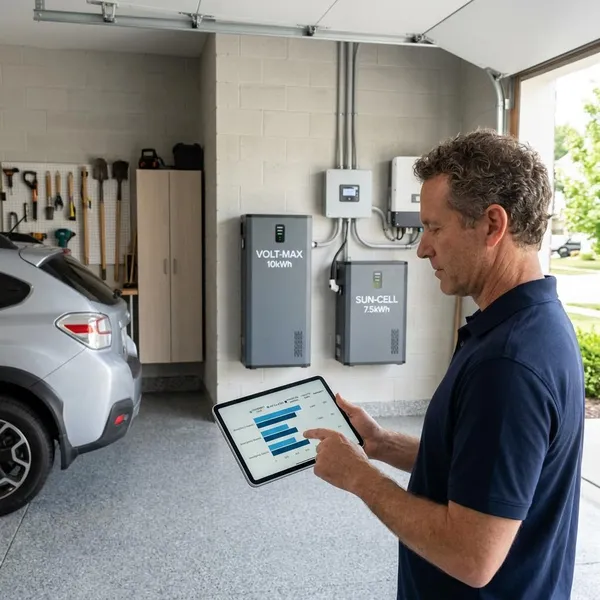
How much does a solar battery cost?
A small battery-only product may cost a few thousand dollars, while a fully installed home battery system can easily reach $10,000 to $15,000 or more. The wide range comes from one simple problem: not every quote includes the same items.
Battery size affects the overall price
Battery size is usually the first big price driver. A 5 kWh battery may cover a few essentials for short outages, while a 10 to 15 kWh setup gives more room for evening use or longer backup time.
Installation adds to the total system cost
Installation can change the final price as much as the battery choice itself. A straightforward garage-wall installation with compatible equipment is very different from a retrofit that needs panel work, backup circuits, or extra communication hardware.
- Battery and required hardware: Check whether the quote includes the inverter, gateway, disconnects, breakers, mounting, and monitoring equipment.
- Electrical work: Older panels, crowded breaker boxes, or a new critical-load subpanel can increase labor cost.
- Backup setup: Whole-home backup usually costs more than backing up selected essentials.
- Permits and inspections: These may be included in one quote and listed separately in another.
Ask each installer for the same breakdown. It is much easier to compare two quotes when you can see which one includes the parts that actually make the battery usable.
Incentives can reduce the final price
Rebates, tax credits, and utility programs may lower the out-of-pocket cost, depending on where you live and whether the battery meets the program rules. In the United States, some residential battery systems may qualify for federal clean energy incentives, and local programs can add more savings in certain areas.
Treat incentives as a discount on a good system, not a reason to buy the wrong one. A battery that is too small, hard to expand, or poorly matched to your backup needs is not a strong value just because the final price looks lower after credits.
What affects solar battery prices?
Solar battery prices are shaped by more than storage size. Chemistry, usable capacity, power output, efficiency, warranty terms, software, and brand support all affect what you really get for the money.
Battery capacity changes the purchase cost
More capacity usually means a higher purchase price, but advertised capacity can be misleading. A battery sold as 10 kWh may not give you the full 10 kWh for daily use because of reserve settings, depth-of-discharge limits, or system protection rules.
A cleaner comparison is cost per usable kWh:
- Start with the installed cost, not just the battery-only price.
- Find usable capacity, not only the headline capacity.
- Divide cost by usable kWh to compare systems more fairly.
- Check cycle life and warranty before choosing the lowest number.
This quick calculation will not tell you everything, but it catches many bad comparisons before you spend time on the wrong quote.
Battery type affects performance and lifespan
The battery chemistry changes how much usable energy you get, how often the battery can be cycled, how much maintenance it needs, and how soon replacement may become an issue. That is why a lower upfront price can still be more expensive over the life of the system.
Daily solar shifting favors longer-lasting lithium options. Occasional backup at a cabin, shed, or seasonal property may make a cheaper AGM or lead-acid setup more reasonable if the drawbacks are acceptable.
Features and warranty affect long-term value
A battery with good monitoring, useful load control, and clear warranty terms can be worth more than a cheaper battery that leaves you guessing. This matters most if you plan to depend on the system often, not just keep it for rare outages.
- Warranty limit: Look for years, throughput limits, and guaranteed remaining capacity.
- Monitoring: A clear app helps you see charge level, usage, and alerts.
- Expansion: Modular systems are useful if your future demand may grow.
- Backup response: If outages are common, switching performance and load control matter.

Which solar battery type offers the best value?
LiFePO4 batteries offer the best long-term value
LiFePO4 batteries are usually the best fit for homeowners who expect regular use. They tend to support deeper discharge, longer cycle life, and lower maintenance than older battery types, which helps justify the higher purchase price.
This is the safer value choice if you want to store solar power every afternoon and use it every evening. It is also a strong option when backup reliability matters because the battery is more likely to stay useful over many years of repeated charging and discharging.
AGM batteries offer affordable storage for simple systems
AGM batteries can make sense for lighter-duty systems where low upfront cost is more important than maximum lifespan. They are sealed and simpler to own than flooded lead-acid batteries, but they usually cannot match LiFePO4 for daily cycling.
A realistic use case would be a small off-grid cabin, a seasonal setup, or occasional backup where the battery is not deeply discharged every day. For a full-time home trying to reduce electric bills year-round, AGM can become less attractive once replacement timing is considered.
Lead-acid batteries offer lower upfront costs
Lead-acid batteries still appeal when the purchase budget is tight, especially for basic backup or small off-grid projects. Their main advantage is the lower starting price.
The trade-off is weight, lower efficiency, shorter lifespan, and in some cases more maintenance. For a permanent residential solar battery system, lead-acid is usually a budget compromise rather than the best long-term value.
How do you choose the right solar battery size?
Match battery capacity with daily energy use
Start with your utility bill and look at average daily electricity use in kWh. Then narrow it down to the portion you actually want the battery to cover, especially the evening and overnight loads.
A home using 25 kWh per day does not automatically need a 25 kWh battery. If the goal is evening lights, refrigeration, electronics, and a few outlets, a smaller battery may be the better value. If the home has high nighttime demand, electric heating, or large appliances you expect to run from storage, the size requirement changes.
Size storage based on backup power needs
For backup power, make a short list of what must keep running. This is more useful than asking for "whole-home backup" before knowing the cost.
- Short outage comfort: Refrigerator, lights, router, phone charging, and a few outlets.
- Safety or property protection: Medical devices, sump pump, security system, or well pump.
- Higher-demand backup: Microwave, garage door opener, selected kitchen circuits, or limited HVAC use.
Consider future electricity demand
Think about the next five to ten years before locking in a system. An electric vehicle, heat pump, heat pump water heater, home office, or larger household can change your storage needs.
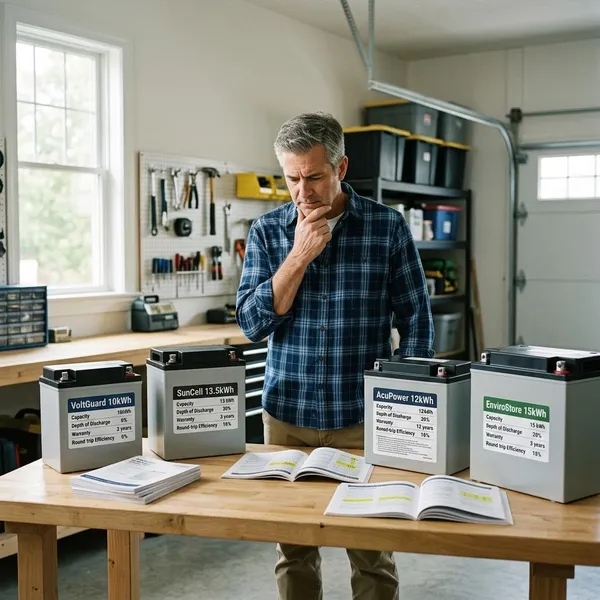
What mistakes should you avoid when buying a solar battery?
Most bad battery purchases come from comparing the wrong number. The lowest quote is not helpful if it leaves out required hardware, provides less usable storage than expected, or cannot support the loads you care about during an outage.
Choosing price over overall value
A low sticker price can hide weak efficiency, limited usable capacity, shorter life, or missing installation components. The better comparison is total installed cost against usable kWh, warranty strength, expected service life, and backup capability.
If two quotes are close, I would usually favor the one with clearer warranty terms, better installer support, and a system design that matches the loads you actually want to run. Those details are easier to appreciate after the first outage than before it.
Ignoring usable capacity and lifespan
Advertised capacity is not the same as usable capacity. Ask for the usable kWh in writing, then compare that number with the warranty and expected cycle life.
This matters most for daily use. A battery used every evening needs stronger cycle performance than a battery kept mostly for rare outages. If you ignore lifespan, the cheaper option may simply move the cost into an earlier replacement.
Buying without considering future needs
A battery sized only for today can become frustrating if your electricity use rises. This is common when households add an EV, move more appliances to electric, or start working from home more often.
Before choosing, ask whether the battery platform is expandable, whether the inverter can handle added storage, and whether backup circuits can be adjusted later. If the answer is no, make sure the upfront savings are worth that limitation.
Conclusion
The best deal is the battery that fits your real use case, not the one with the lowest advertised price. Compare total installed cost, usable kWh, battery chemistry, warranty, and future expandability first; if a quote is vague on those points, it is worth slowing down before you buy.