
How Do Silicon Carbon and Solid State Batteries Differ?
Silicon carbon battery vs solid state battery compares available silicon carbon cells with emerging solid-state designs on safety, density, and use cases.
In the silicon carbon battery vs solid state battery comparison, silicon-carbon batteries are more likely to reach consumer devices sooner, while solid-state batteries offer greater long-term potential. Silicon-carbon technology upgrades conventional lithium-ion batteries by using silicon to increase energy storage, whereas solid-state designs replace the liquid electrolyte with a solid material. As a result, silicon-carbon batteries represent a nearer-term improvement, while solid-state batteries could eventually deliver stronger gains in safety, capacity, and durability.
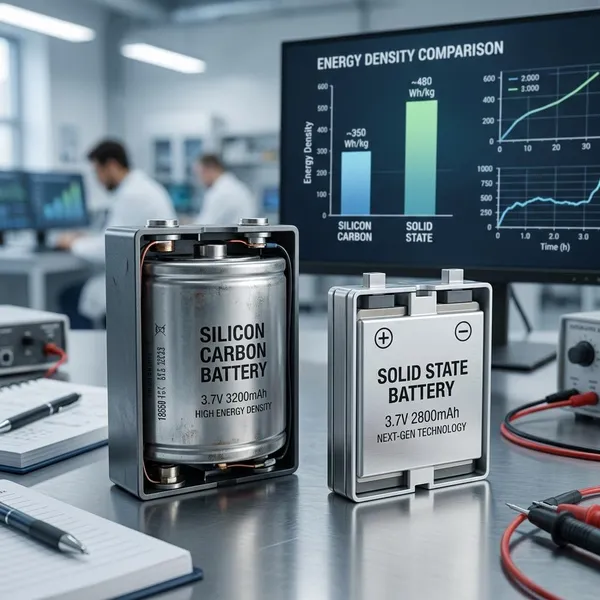
What are the main differences between silicon-carbon and solid-state batteries?
The easiest way to separate the two is to ask what is being changed. Silicon-carbon batteries improve the anode material inside a lithium-ion-style battery. Solid-state batteries replace the liquid or gel electrolyte with a solid electrolyte, which can change the whole cell design.
Silicon-carbon batteries improve materials while solid-state batteries change the design
A silicon-carbon battery is still part of the lithium-ion family, but it uses silicon blended with carbon-based materials to store more lithium than a traditional graphite-heavy anode. That can raise capacity without forcing a completely new battery platform.
A solid-state battery makes a bigger design change by using a solid electrolyte. That can open the door to different packaging, different safety behavior, and possibly higher energy density later, but it also makes manufacturing harder.
| Comparison point | Silicon-carbon battery | Solid-state battery |
|---|---|---|
| Main change | Improved anode material | Solid electrolyte and cell redesign |
| Closest use case today | Phones and portable electronics | Prototypes, testing, future EVs |
| Buyer takeaway | More relevant for current products | Worth watching, not yet common |
Silicon-carbon batteries are available sooner while solid-state batteries need more development
Silicon-carbon is easier to bring into real products because it builds on existing lithium-ion production knowledge. A phone brand can use it to chase more capacity in a thin body without waiting for a completely new battery supply chain.
Silicon-carbon batteries improve current devices while solid-state batteries target future uses
For a daily phone, tablet, or compact power bank, silicon-carbon is the more practical improvement: more stored energy in a small space. For a long-range EV, aircraft platform, or high-end industrial system, solid-state is more interesting because the potential payoff is larger if the technology scales.
Which battery has higher energy density?
For products you can realistically buy soon, silicon-carbon has the clearer near-term advantage. For future maximum energy density, solid-state has the higher ceiling, but that depends on designs that are not yet widely commercialized.
Silicon-carbon batteries provide higher density in current products
Silicon can store more lithium than graphite, so a silicon-carbon anode can help fit more capacity into the same physical space. That is why the technology is attractive for thin smartphones, foldables, wearables, and other devices where a few extra millimeters matter.
- Phone buyer: look for real battery capacity and independent runtime tests, not just chemistry claims.
- Power bank buyer: check size, weight, watt-hour rating, and charging support together.
- Thin-device buyer: expect the benefit to show up as either longer runtime or slimmer design, not always both.
Solid-state batteries offer higher future energy density potential
Solid-state batteries may eventually support higher energy density through solid electrolytes, tighter cell packaging, and possible lithium-metal anodes. That is the reason EV makers and battery startups keep investing in them.
The catch is the gap between a strong lab result and a durable mass-market product. A battery that looks excellent in a test cell still has to survive repeated charging, heat, vibration, and years of real use before it matters to most buyers.
Real battery performance depends on design and manufacturing limits
Do not judge either technology by energy density alone. The useful checklist is weight, size, cycle life, charging speed, heat control, and warranty confidence. A drone battery may prioritize low weight, while an EV pack needs durability, safety systems, and predictable aging over many years.
How do silicon-carbon and solid-state batteries compare in safety?
Both technologies can improve safety, but neither should be treated as automatically safe in every product. Silicon-carbon relies on better material control inside a familiar lithium-ion platform. Solid-state aims to reduce some electrolyte-related risks, but it still has engineering challenges.
Silicon-carbon batteries improve safety through better materials
Silicon-carbon batteries can benefit from mature lithium-ion safety practices, battery management systems, and manufacturing experience. The main engineering issue is that silicon expands and contracts during charging, so the cell needs coatings, binders, and structural control to keep degradation in check.
Solid-state batteries improve safety with solid electrolytes
Solid electrolytes are generally less prone to leakage and may reduce flammability concerns compared with conventional liquid electrolytes. That makes solid-state especially appealing for EVs, where pack safety and heat behavior are major concerns.
- Possible benefit: lower electrolyte flammability risk.
- Still unresolved: cracking, interface stability, and dendrite control in some designs.
- Practical test: large-scale validation matters more than the word "solid-state" on its own.
Both technologies still face durability challenges
Silicon-carbon must manage anode expansion over repeated cycles. Solid-state must keep solid layers in good contact as the cell charges, discharges, heats, and cools.
This is where usage matters. A phone charged gently overnight is a different case from an EV repeatedly fast-charged on hot summer road trips. The higher the stress, the more you should care about cooling, battery management, and long-term testing rather than chemistry labels alone.

Which battery technology is available today?
Silicon-carbon batteries are already appearing in selected consumer electronics. Solid-state batteries exist in research, prototypes, pilot lines, and limited testing, but they are not yet a normal feature in mainstream phones or mass-market EVs.
Silicon-carbon batteries are already used in consumer electronics
Smartphones are the clearest near-term home for silicon-carbon batteries because buyers want longer runtime without thicker devices. The chemistry may not always be advertised in the same way across markets, so check the actual battery capacity, charging behavior, and reviews instead of assuming the label tells the whole story.
Solid-state batteries are still in development and testing
Solid-state batteries are real, but broad consumer availability is still limited. The hard part is not making one promising cell; it is making many cells consistently, affordably, and safely enough for demanding products.
For EV shoppers, that means a solid-state announcement should be read carefully. A prototype, a pilot production plan, and a vehicle you can buy with a clear warranty are three very different milestones.
Different industries will adopt battery technologies at different speeds
Small electronics can adopt new battery materials faster because packs are smaller and product cycles are shorter. Automotive moves more slowly because batteries must handle crashes, temperature swings, fast charging, long warranties, and years of degradation.
Specialized fields such as aerospace, medical equipment, and defense may move on their own timeline. They may pay more for performance, but they also demand stricter validation.
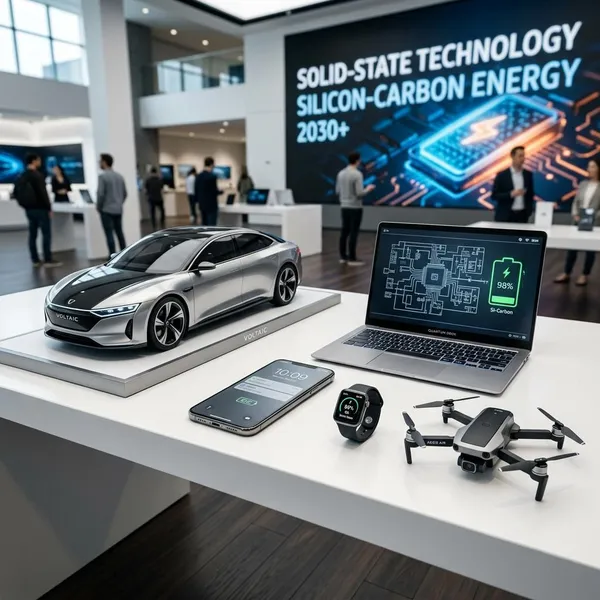
Which devices will use silicon-carbon or solid-state batteries?
The likely split is not one winner replacing the other everywhere. Silicon-carbon fits devices that need better batteries soon. Solid-state fits applications where a bigger technology shift may be worth the cost and delay.
Silicon-carbon batteries fit smartphones and portable devices
Silicon-carbon is a strong fit for smartphones, tablets, wearables, cameras, and compact power banks. These products benefit from higher capacity in tight spaces, and they do not require the same multi-year durability proof as an EV battery pack.
Solid-state batteries target electric vehicles and long-range applications
Solid-state batteries are most often linked with EVs, premium mobility, aerospace, and other long-range or high-safety applications. The appeal is clear: more range, better thermal behavior, and safer packaging are valuable if the cells can be produced reliably.
For EVs available now, proven lithium-ion packs remain easier to evaluate. For future EVs, solid-state could become a major upgrade if cost, cycle life, fast charging, and cold-weather performance are proven at scale.
Both technologies improve laptops, drones, and high-performance devices
Laptops, drones, handheld tools, and performance electronics sit in the middle. A lightweight drone might benefit from silicon-carbon sooner because weight and compactness matter immediately. A premium laptop could adopt whichever technology gives the best balance of runtime, heat, price, and safety at the time.
- Choose silicon-carbon first when the product is small, current, and space-limited.
- Watch solid-state when the product needs long range, heavy safety validation, or premium performance.
- Ignore the hype if the brand does not explain availability, warranty, or real-world testing.
Conclusion
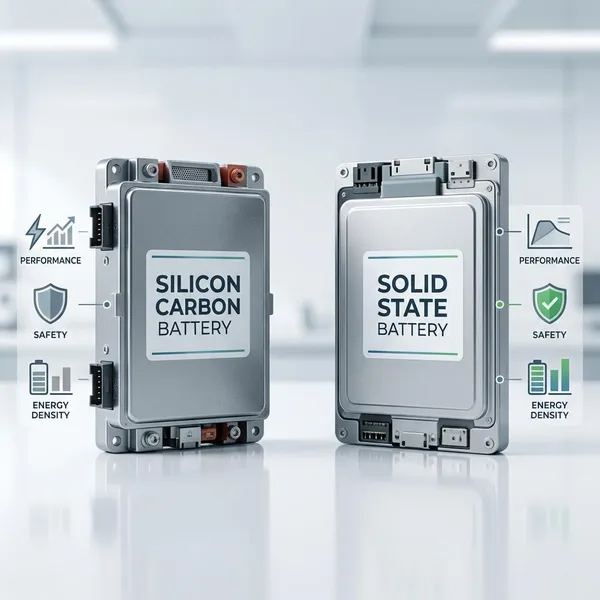
For most people, silicon-carbon is the battery technology to take seriously in the near term, especially for phones and portable devices. Solid-state is the more ambitious future option, particularly for EVs, but it still needs broader proof outside controlled testing. If you are buying a product now, judge the finished device by runtime, charging behavior, safety controls, and warranty support; if you are watching future EVs, solid-state is worth following but not worth assuming as standard yet.