
What Size Solar Generator Can Run Your Fridge?
Find the best solar generator for refrigerator backup by comparing wattage, battery size, runtime, and charging options.
Choosing the best solar generator for refrigerator backup comes down to more than battery size. To keep food cold during a blackout, you need a system that can handle the refrigerator's startup surge, cover its real daily energy use, and recharge reliably if the outage lasts overnight or longer.
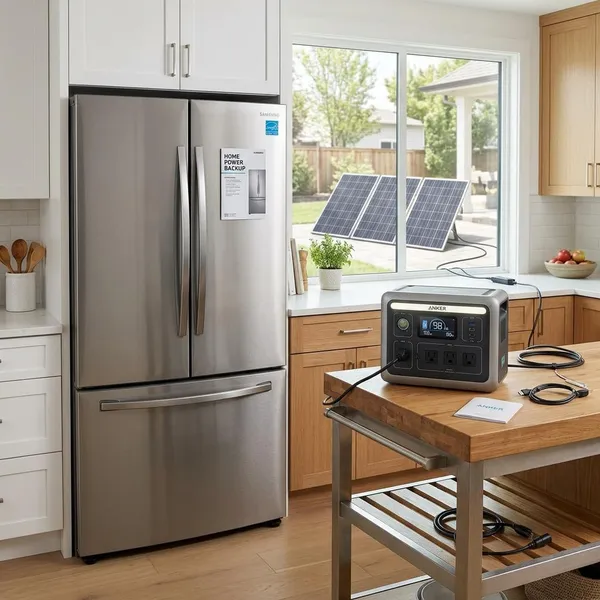
How much power does a refrigerator need?
Running watts determine normal power use
Many full-size refrigerators run somewhere around 100 to 250 watts while the compressor is on, although the exact number depends on size, age, efficiency, room temperature, and features such as ice makers. A compact fridge may use less, while an older garage refrigerator can use more than expected.
The most useful check is not a guess from a product page. Look for the label inside the fridge, check the manual, or use a plug-in watt meter for a day. If you are buying a generator for a storm-prone home, that real reading is worth more than a generic estimate.
Startup surge determines the required inverter capacity
The compressor can briefly need two to three times its normal running wattage when it starts. That is why a fridge that seems to run at only 150 watts may still need a solar generator with a much higher surge rating.
- For many modern refrigerators: a 1000W pure sine wave inverter with good surge capacity is often enough.
- For older or larger models: 1500W or more may be the safer target.
- For uncertain appliances: choose more inverter headroom rather than sizing right at the limit.
Pure sine wave output is the better choice for refrigerator motors and electronics. Avoid assuming that "high capacity" automatically means the inverter can handle compressor startup.
Daily energy use determines battery size
Battery size should be planned from watt-hours, not just watts. Many household refrigerators use roughly 1 to 2 kWh per day, but the EnergyGuide label or a watt meter gives a better estimate for your own appliance.
A simple calculation helps: if the label says 438 kWh per year, divide by 365. That is about 1.2 kWh per day. Since inverter losses reduce usable energy, a 1000Wh power station will not usually give a full day of backup for that fridge.
What size solar generator do you need for a refrigerator?
Small generators work for mini fridges and compact cooling
Small solar generators, roughly in the 300Wh to 700Wh range, are best for mini fridges, dorm refrigerators, beverage coolers, and short-term cooling needs. They are easy to store and carry, which makes them useful for renters, road trips, and occasional emergency use.
They are usually not the best fit for a full-size kitchen refrigerator. Even if the inverter starts the compressor, the battery may drain too quickly to protect food through the night.
Medium generators fit standard home refrigerators
For many homes, the practical middle ground is about 1000Wh to 1500Wh of battery capacity with a 1000W to 1800W pure sine wave inverter. This range often handles a standard efficient refrigerator during a short outage and still stays portable enough to move around the house.
This is the category I would look at first if the goal is basic food protection rather than whole-home backup. It also gives some room for small essentials such as a phone charger, router, LED light, or fan, as long as the refrigerator remains the priority.
Large generators support refrigerators and freezers
Large systems usually start around 2000Wh and make more sense when you need longer backup, want to run both a refrigerator and a freezer, or live somewhere outages can stretch beyond one night. They cost more and weigh more, but they reduce the constant worry of watching the battery percentage drop.
| Use case | Better size range | When it makes sense |
|---|---|---|
| Mini fridge or beverage cooler | 300Wh–700Wh | Travel, dorms, camping, brief outages |
| Standard kitchen refrigerator | 1000Wh–1500Wh | Short outages and basic home backup |
| Refrigerator plus freezer | 2000Wh+ | Longer outages, summer backup, larger households |
If you store expensive frozen food, medication, or bulk groceries, sizing up is usually more sensible than buying the smallest unit that might technically work.
Which solar generator is best for refrigerator backup?
Best overall solar generator for most refrigerators
A medium-capacity LiFePO4 power station with about 1000Wh to 1500Wh of storage and a 1000W to 1800W pure sine wave inverter is the strongest all-around choice for many standard refrigerators. It gives a useful balance of startup support, runtime, price, and portability.
- Prioritize surge rating first so the compressor can start reliably.
- Choose LiFePO4 if possible for longer cycle life and better long-term value.
- Check solar input if you want more than one day of backup.
- Treat app features as optional rather than a reason to ignore core power specs.
Best budget solar generator for short outages
A budget setup can work if your expectations are realistic. Look for at least around 700Wh to 1000Wh of capacity and an inverter strong enough for your refrigerator's startup surge.
This choice fits apartment residents, occasional outage planning, or someone who mainly wants to bridge short blackouts. It is not ideal if your area regularly loses power overnight in hot weather, because the reserve margin is limited.
Best high-capacity solar generator for long backup
For long backup, choose 2000Wh or more, a strong pure sine wave inverter, and enough solar input to make daytime recharging worthwhile. This size is also the safer choice for a refrigerator and freezer running together.
The extra capacity is not just about comfort. It gives you a buffer for cloudy weather, repeated compressor starts, higher indoor temperatures, and a few small emergency loads. If losing the contents of your freezer would be expensive, a larger system is easier to justify.
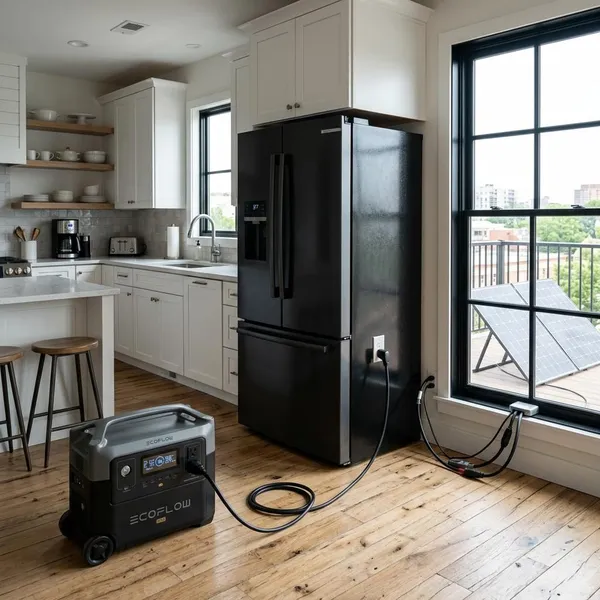
How long can a solar generator run a refrigerator?
Battery capacity determines backup runtime
A 500Wh unit may only provide short coverage for a standard refrigerator. A 1000Wh unit may cover several hours to part of a day. A 2000Wh unit can often support an efficient refrigerator for around a day or longer, depending on conditions.
For example, if your fridge uses about 1200Wh per day and your power station has 2048Wh, the usable energy after losses may be closer to 1700Wh to 1850Wh. That could be roughly a day and a half in moderate conditions, but less in a hot kitchen or with frequent door openings.
Refrigerator usage affects daily power consumption
How you use the fridge during the outage matters more than most people expect. Opening the door repeatedly, adding warm food, or keeping the appliance in a hot garage can make the compressor run longer and drain the battery faster.
- Open the door with a plan: decide what you need before opening it.
- Keep warm food out: let leftovers cool before adding them.
- Improve airflow: avoid blocking the back or sides of the refrigerator.
- Check door seals: weak seals waste cold air and battery power.
Extra capacity provides longer outage protection
Extra battery capacity is most valuable when conditions are not ideal. A setup that barely works in mild weather may disappoint during a summer blackout, when the compressor cycles more often and solar charging may be interrupted by storms.
If your refrigerator uses about 1.2 kWh per day, a 1 kWh unit is a short-term helper. A 2 kWh system is a more realistic outage tool, especially if you want overnight confidence or need to power one or two small essentials at the same time.
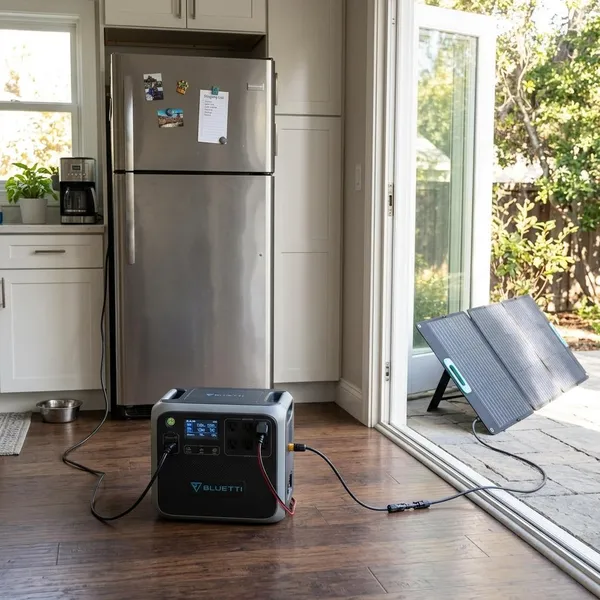
How do you recharge a solar generator for refrigerator use?
Solar panels provide off-grid charging power
Solar panels are what make the setup useful beyond a single battery cycle. If your refrigerator uses around 1.2 kWh per day, you may need roughly 400W to 800W of panels to replace a meaningful amount of energy in real conditions, depending on sun, shade, panel angle, and weather.
Portable panels are convenient for occasional use, while fixed or larger panel setups are better for repeat outages. If your main concern is multi-day emergency backup, do not undersize the panels and expect the battery to recover quickly.
Wall charging restores power faster
Wall charging is usually the quickest and most predictable option. It is useful before a storm, after grid power returns, or during rolling outages when you may only have a short window to refill the battery.
For most households, the simplest routine is to keep the power station charged from the wall before bad weather, then use solar panels only if the outage lasts long enough to need off-grid recharging.
Car charging helps during travel and emergencies
Car charging is slow, but it can still be useful when you are traveling, evacuating, camping, or dealing with a local outage and have no other option. It is better as a backup charging method than as your main plan for a full-size refrigerator.
Expect limited power from a standard vehicle outlet. If you rely on car charging, test the setup before an emergency so you know how much energy it actually adds in an hour.
Conclusion
For most homes, the smartest choice is a solar generator with enough surge capacity to start the compressor, enough watt-hours to cover the outage you realistically expect, and charging options that match your situation. A medium LiFePO4 unit is often the best balance for one standard refrigerator, while longer outages, summer heat, or a refrigerator-plus-freezer setup usually justify moving up to a larger system.