Which Rechargeable Batteries Do Solar Lights Need?
Choose the right rechargeable batteries for solar lights with clear guidance on NiMH, NiCd, lithium, voltage, size, runtime, and lifespan.
If your solar lights are fading early or not staying on through the night, the right replacement battery can make a bigger difference than buying a larger-capacity pack at random. The best rechargeable batteries for solar lights are the ones that match your fixture’s original size, voltage, and battery chemistry while fitting the amount of sunlight the panel can actually collect each day.
What are the best rechargeable batteries for solar lights?
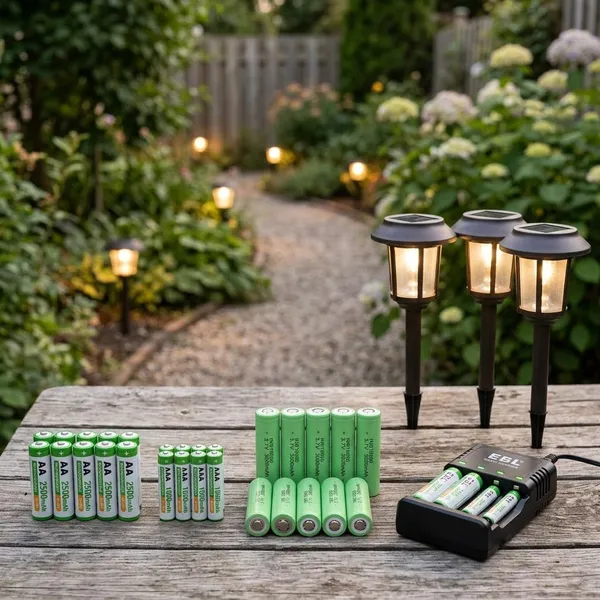
For most everyday garden and pathway lights, NiMH batteries are usually the safest all-around choice. Older fixtures may still need NiCd, while brighter spotlights and security lights often use lithium batteries or lithium battery packs.
The important part is compatibility. A battery can look right and still be wrong if the voltage or chemistry does not match the charging circuit inside the light.
| Battery type | Best fit | Main caution |
|---|---|---|
| NiMH | Most newer garden, pathway, and decorative solar lights | Use only where 1.2V NiMH cells are supported |
| NiCd | Older solar lights originally built for NiCd cells | Lower capacity and less ideal environmentally |
| Lithium | Brighter spotlights, wall lights, and security lights | Must match the exact lithium chemistry and voltage |
NiMH batteries fit most standard solar lights
NiMH batteries are the right starting point for many modern solar stake lights, pathway lights, and small lanterns. They are commonly sold in AA and AAA sizes, offer decent runtime, and handle the daily charge-discharge cycle that outdoor solar lights go through.
They make the most sense for regular household use: a row of path lights along a driveway, small garden lights used every night, or decorative patio lights that need steady rather than intense brightness.
NiCd batteries fit older solar light models
Older solar lights often work best with the same NiCd chemistry they originally used. If the old battery label says NiCd and the manual gives no approved alternative, replacing like with like is usually the lower-risk choice.
NiCd batteries are not usually the best upgrade for a newer fixture, but they can be practical for legacy lights with simple charging circuits. A very old set of decorative stake lights, for example, may behave more predictably with NiCd than with a newer chemistry the circuit was never designed to charge.
Which rechargeable batteries work for solar lights?
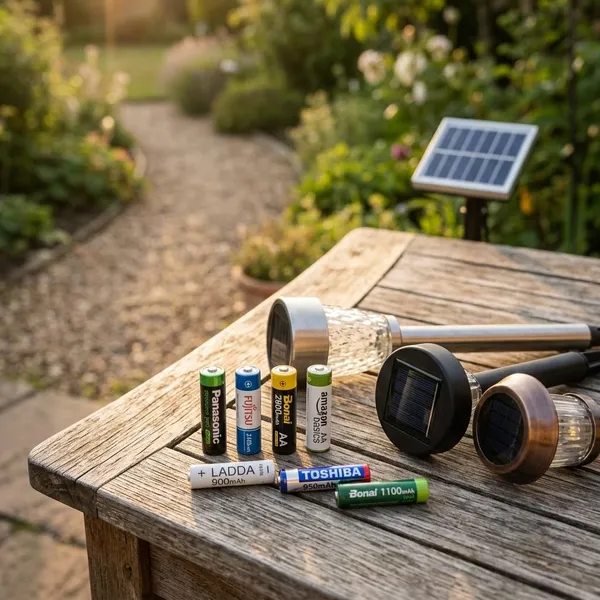
The batteries that work are rechargeable cells made for the light’s voltage and charging design. In practical terms, most household solar lights use NiMH, NiCd, or lithium-based batteries.
A good rule is simple: if the old battery is readable, copy its size, voltage, chemistry, and a similar mAh rating. Only change chemistry when the product information clearly says the light supports it.
NiMH batteries provide reliable daily use
NiMH batteries are a good fit when the light charges in daylight and runs gently through the evening. They suit everyday outdoor lights where consistency matters more than maximum brightness.
- Good for: pathway lights, garden stakes, small lanterns, patio accents.
- Best situation: daily use in a spot that gets several hours of direct sun.
- Avoid when: the original battery or manual clearly specifies NiCd only.
NiCd batteries support older systems
NiCd batteries still have a place in older fixtures because many older charging circuits were built around them. If you are trying to keep an old but working set of lights alive for another season, NiCd can be the most practical replacement.
The tradeoff is runtime. A NiCd cell may restore the light, but it may not keep it glowing as long as a newer NiMH-powered model.
How do you choose a replacement battery?
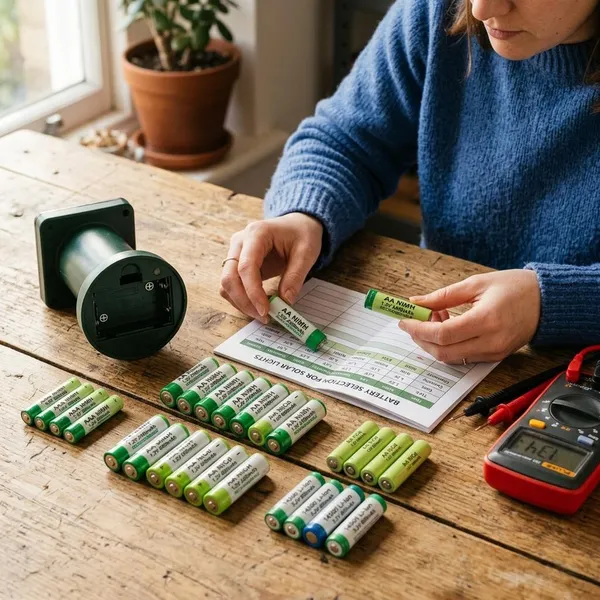
Choose the replacement in this order: physical size, voltage, chemistry, then capacity. Capacity matters, but it should not come before compatibility.
This is where many disappointing replacements happen. A higher mAh rating may sound better, but a small solar panel may never fully recharge that battery, especially in winter or in a shaded garden bed.
Match the battery size and fit
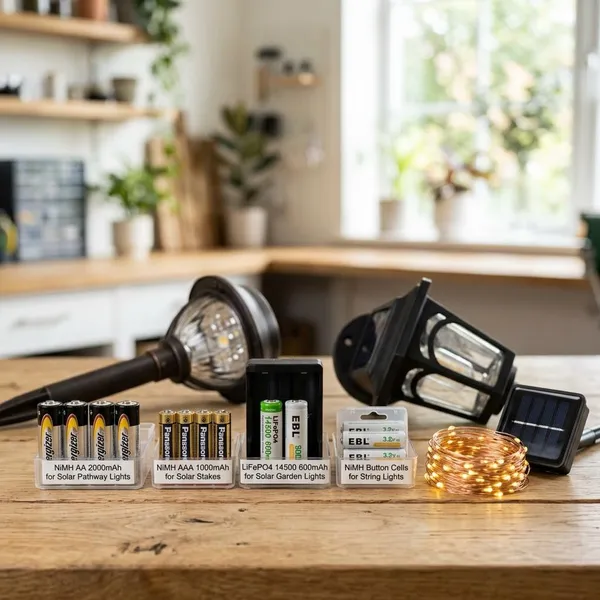
Start with the physical format. Many small solar lights use AA or AAA rechargeable cells, while brighter models may use 14500 lithium cells or a custom battery pack with wires.
Do not judge by appearance alone. A 14500 lithium cell can look similar to an AA battery, but it is not an AA replacement unless the light was designed for that cell type.
Match the voltage and chemistry
Voltage and chemistry are the checks that protect the light from poor charging or damage. Standard NiMH and NiCd solar cells are often 1.2V, while lithium systems may use ratings such as 3.2V or 3.7V depending on the chemistry.
- 1.2V NiMH: replace with 1.2V NiMH unless another option is approved.
- 1.2V NiCd: stay with NiCd if the light is older and no NiMH support is listed.
- 3.2V LiFePO4: do not swap for 3.7V lithium-ion.
- Battery pack: match voltage, chemistry, connector, and shape.
Which batteries fit different solar lights?
The right battery also depends on what the light is expected to do. A soft garden marker, a landscape spotlight, and a motion security light do not use power in the same way.
Think about the job first: soft accent light, longer evening runtime, or high-output motion lighting. That usually narrows the battery choice faster than comparing battery labels alone.
Garden lights need reliable everyday batteries
Garden lights usually need dependable daily charging rather than high power. For newer AA or AAA fixtures, NiMH is usually the best fit because it gives a good balance of runtime, price, and easy replacement.
If you have a large set of matching lights, replace weak batteries in groups rather than mixing old and new cells across the same fixture style. That keeps brightness and runtime more consistent from light to light.
Spotlights need longer runtime batteries
Spotlights use more energy because they aim stronger light at a tree, wall, sign, or pathway. A model with replaceable AA cells may use higher-quality NiMH batteries, while a brighter integrated model may use a lithium pack.
Before blaming the battery, look at the panel. A spotlight under a branch, near a roof edge, or covered with dust may still run short even with the correct replacement.
How do you replace solar light batteries?
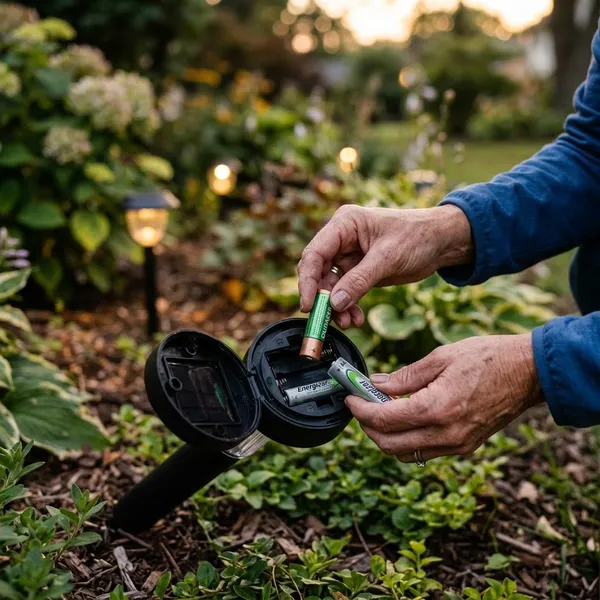
Replacing the battery is usually simple, but it is worth doing carefully because outdoor lights collect moisture, dust, and corrosion. A clean contact and a properly seated battery can matter as much as the battery itself.
Use the replacement as a quick inspection point: if the compartment is wet, rusty, or cracked, a new battery may only fix the problem temporarily.
Open the battery compartment safely
Turn the light off if it has a switch, wipe the outside dry, and open the cover with the correct screwdriver. Avoid forcing plastic tabs because a damaged seal can let water in later.
A quick phone photo before removing the old battery helps if the plus and minus markings are hard to see.
Clean the battery contacts
Dirty or corroded contacts can make a good battery look dead. Wipe the metal contacts with a dry cloth or cotton swab, and let the compartment dry fully before installing the replacement.
If there is light corrosion, a small amount of white vinegar on a swab may help loosen it. If the metal is badly eaten away, the fixture may need repair or replacement.
Install the correct replacement battery
Match the polarity marks, seat the battery firmly, and close the cover so the seal sits flat. If the light uses more than one cell, use matching batteries rather than mixing old and new cells.
- Do not force the cover: the battery may be the wrong size.
- Do not mix chemistries: NiMH, NiCd, and lithium are not interchangeable by guesswork.
- Do not pull pack wires: loosen the connector gently if the light uses a battery pack.
Test the light after charging
Give the light a full day in direct sun before judging the result. Then cover the solar panel or move the light into darkness to see whether it turns on normally.
If it still fails, check the simple things first: dirty panel, shaded location, switched-off setting, corroded contacts, or a blocked light sensor. A new battery cannot compensate for a panel that is not getting enough daylight.
Conclusion
For most standard solar lights, choose a matching NiMH battery unless the original label points to NiCd or a lithium pack. The smartest replacement is not the highest-capacity battery on the shelf; it is the one your light can fit, charge, and use reliably in its real outdoor location.