Which Portable Solar Battery Charger Is Right for You?
Find the best portable solar battery charger for camping, hiking, travel, and outages.
The best portable solar battery charger depends on what you need to keep powered. A compact solar power bank can handle phone backup, a foldable solar panel paired with a small battery is better for hiking, and a portable power station is the smarter choice for camping, RV use, or power outages. Choosing the right option starts with your devices, charging needs, and how long you'll be away from a wall outlet.
What Is the Best Portable Solar Battery Charger?
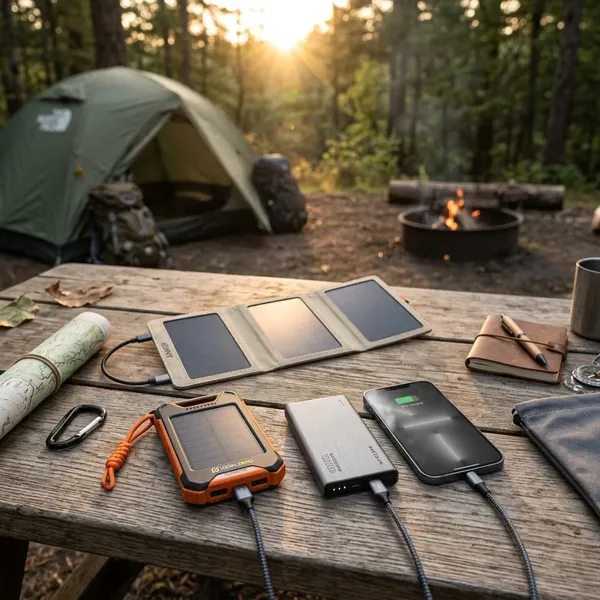
A portable solar battery charger can mean three different things: a solar power bank, a foldable solar panel, or a larger power station that accepts solar input. They are often sold under similar names, but they solve different problems.
If you only need to keep a phone alive during travel, choose small and simple. If you spend full days away from outlets, choose more panel area. If the goal is backup power for several devices, battery capacity matters more than pocket-size portability.
Solar power banks are best for everyday charging
Solar power banks are useful for commuting, travel days, beach bags, festivals, and basic emergency kits. The built-in battery does most of the work, while the small solar panel is better treated as a slow backup source rather than your main charging method.
- Good fit: one phone, earbuds, a flashlight, or light backup use.
- Weak fit: multi-day camping, laptops, fans, or fast solar recharging.
- First check: USB-C support, realistic battery capacity, and a durable case.
Foldable solar chargers are best for outdoor trips
A foldable solar charger is usually the better choice when you can leave panels in direct sunlight for a few hours. More surface area means more useful solar input, which matters for hiking breaks, road trips, kayaking stops, or a sunny campsite.
The practical setup is often a foldable panel charging a small battery bank first. Direct phone charging can stop and restart when clouds pass or the panel angle changes, while a battery bank handles those interruptions more smoothly.
Portable power stations are best for larger devices
Portable power stations are the right category when you want to run more than handheld electronics. Depending on the model, they may support phones, lanterns, cameras, laptops, routers, battery fans, or low-watt medical devices.
They are heavier and more expensive, so they do not make sense for a light day hike. For car camping, RV weekends, or blackout planning, however, stored energy is the main advantage: you have power ready before the sun comes out.
Best Portable Solar Battery Chargers by Use Case
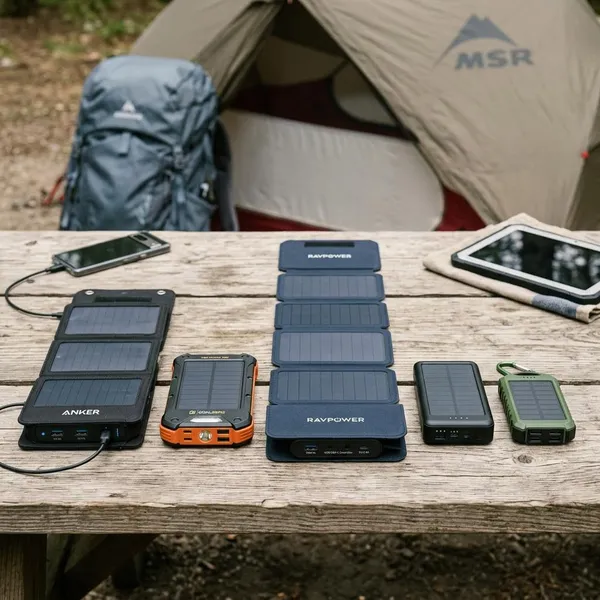
The easiest way to avoid buying the wrong charger is to match the setup to your real routine. A person who wants phone backup during a summer day trip does not need the same gear as someone preparing for winter outages or running devices at a campsite.
| Use case | Best direction | Watch out for |
|---|---|---|
| Daily travel or casual outdoor use | Solar power bank or small panel plus battery bank | Overestimating tiny built-in solar panels |
| Hiking and backpacking | Light foldable panel with a compact battery bank | Buying something too heavy to carry often |
| Camping and RV trips | Larger panel with a power station | Not enough storage for night use |
| Emergency backup | Charged battery or power station with solar as support | Depending on sunlight only during a blackout |
Best overall for daily outdoor charging
For most people, the strongest everyday setup is a mid-size foldable solar panel paired with a small battery bank. It is more useful than a tiny solar power bank panel, but still much lighter and cheaper than a full power station.
This works well for a park day, beach trip, long drive, or weekend away. Let the panel collect power during the brightest part of the day, then charge your phone from the battery later when you are in the shade or back at camp.
Best budget option for basic charging
A budget buyer should usually choose either a simple power bank with solar support or a modest foldable panel from a brand with clear specifications. The mistake is chasing huge capacity claims at a very low price, because cheap chargers often exaggerate both battery size and solar speed.
If your use is occasional, such as keeping a phone alive in a glove box emergency kit or travel pouch, a precharged power bank with slow solar backup can be perfectly reasonable.
Best for camping and RV trips
Camping changes the priorities. Weight matters less, but evening power matters more. A larger panel and portable power station can support phones, lanterns, fans, speakers, camera batteries, and sometimes a laptop, depending on the power station's output limits.
- Weekend car camping: a medium power station and foldable panel usually feel more practical than several small power banks.
- RV use: solar can help reduce generator use for light loads, but it should not be treated as unlimited power.
- Family camping: choose more storage than you think one phone requires, because lights and fans often become the real drain.
Best for emergency backup
For emergencies, start with stored power. A charged power station or battery bank is useful immediately, while solar panels only help when there is enough daylight and safe space to set them up.
Prioritize communication, light, and essential low-power devices before comfort items. If someone depends on medical equipment, check the equipment's wattage, startup draw, plug type, and required runtime before relying on any portable power setup.
Key Features to Look for in a Solar Charger
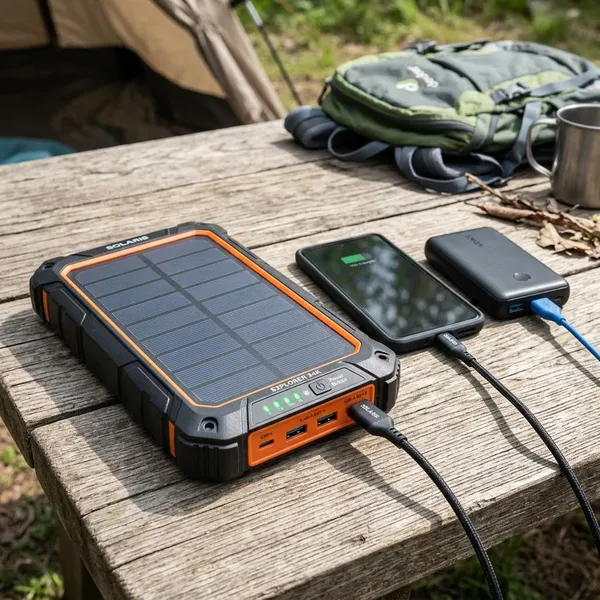
Product pages often lead with big wattage numbers, but real-world usefulness comes from a mix of panel quality, usable battery storage, ports, weight, and protection features. A charger with slightly lower claims can be the better buy if it charges more consistently and fits your devices without adapters.
Check these in order: what you need to power, how long you need it, whether the charger has the right outputs, and whether you can realistically carry or store it. The rest is secondary.
Panel efficiency improves charging consistency
Better panel efficiency helps a portable charger make more usable power from limited space. That matters in morning sun, late afternoon light, or partly cloudy weather, where a poor panel may barely provide useful output.
Do not judge by wattage alone. Look for signs of reliable construction, stable output, and a panel size that matches the job. A small panel can be convenient, but it cannot perform like a much larger surface in the same sunlight.
Output options improve device compatibility
Ports decide what the charger can actually support. USB-A is still useful for small accessories, but USB-C is now important for phones, tablets, battery banks, and many travel devices.
- For phones: USB-C output is usually the most convenient choice.
- For several small devices: check total shared output, not just the number of ports.
- For power stations: confirm whether you need AC outlets, DC output, or USB-C Power Delivery.
Lightweight designs improve portability
A charger only helps if you are willing to bring it. Backpackers usually need a slim foldable panel or compact power bank, while car campers can accept more weight for better capacity.
One simple test helps: imagine packing it on the least convenient day, not the ideal day. If it feels too bulky for a long walk, airport transfer, or crowded daypack, it may stay at home when you actually need it.
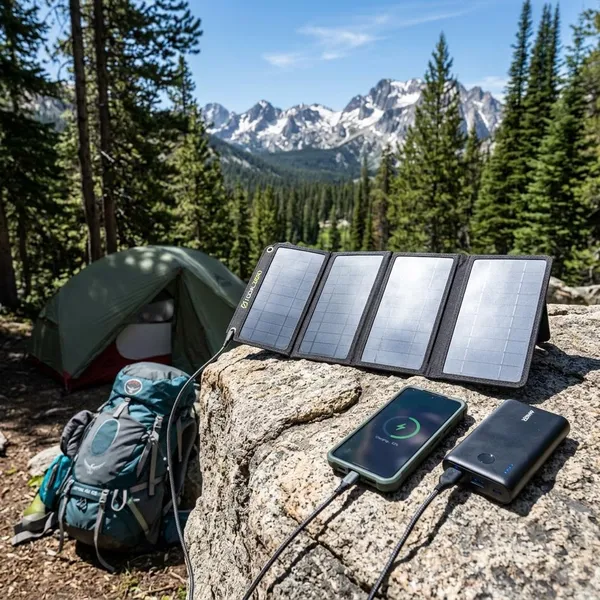
Best Portable Solar Chargers for Camping, Hiking, and Emergencies
Outdoor charging is less about finding one perfect product and more about choosing the right compromise. Hiking rewards low weight. Camping rewards storage and panel size. Emergency use rewards readiness before anything else.
A useful way to think about it: if you are moving all day, carry less and conserve power; if you are staying in one place, collect more sunlight; if the situation is high-risk, keep the battery charged before the problem starts.
Lightweight chargers fit backpacking needs
Backpacking chargers should be simple, light, and tough. A small foldable panel plus a compact battery bank is often enough for a phone, headlamp, GPS watch, or satellite communicator, provided you are careful with power use.
Solar is less dependable on shaded trails or when you are constantly moving. For a forested route or a short overnight trip, a fully charged power bank may matter more than the solar panel. For open desert, coastal, or alpine routes with long sun exposure, a light panel becomes more worthwhile.
Larger chargers support camping setups
At camp, you can set up a panel properly and leave it aimed at the sun. That makes a larger foldable panel much more useful than it would be on a backpacking trip.
Pair it with a battery or power station so daytime sunlight becomes evening power. This is the difference between charging only while the sun is strong and having usable energy for lanterns, phones, and fans after dark.
Backup chargers support emergency situations
An emergency charger should be ready before the outage starts. Keep the battery charged, store the right cables with it, and test the setup with the devices you care about most.
- First priority: phones, radios, lights, and essential medical or safety devices.
- Second priority: router, small fan, rechargeable batteries, or camera gear.
- Lower priority: entertainment devices unless your core needs are already covered.
Solar panels can extend runtime during a longer outage, but they should not be your only plan if weather, smoke, storms, or limited outdoor space could block charging.
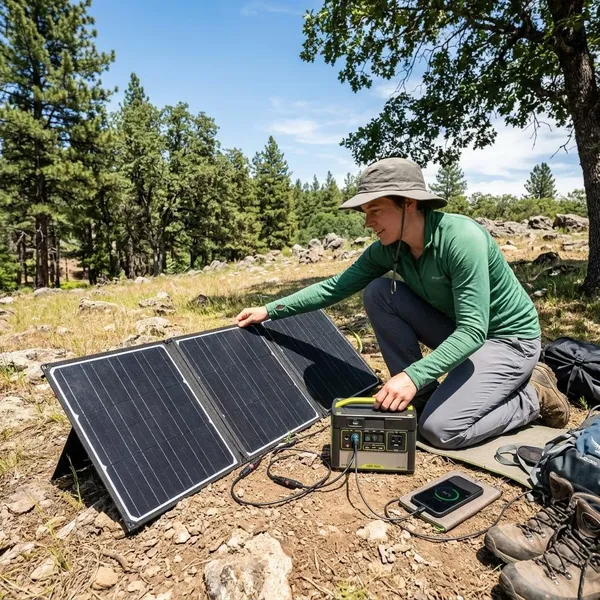
How to Improve Solar Charging Performance
Portable solar charging improves a lot when the setup is intentional. The most important habits are simple: use direct sunlight, store energy in a battery, avoid bad cables, and keep the battery portion out of extreme heat when possible.
Solar will not feel like wall charging, and it should not be judged that way. A good result is steady usable power over time, especially when you collect it during the brightest hours and use it later.
Place panels in direct sunlight
Panel placement is the biggest performance factor. Keep the whole panel out of shade, aim it toward the strongest sun, and reposition it when you are staying in one place for several hours.
Partial shade can hurt output more than beginners expect. A tent edge, branch shadow, backpack strap, or window glass can make a charger seem weak even when the product is fine.
Store power for more stable charging
Charging a battery bank or power station first is usually more reliable than charging a phone directly from the panel. The battery absorbs changes from clouds and shifting light, then gives your device a steadier charge later.
This also solves a timing problem. You can collect power at noon and use it at night, when phones, lights, and emergency devices are more likely to need it.
Conclusion
Choose the smallest setup that honestly covers your real need, not the one with the loudest capacity claim. A solar power bank is fine for light backup, a foldable panel with a battery bank is the practical middle ground for outdoor days, and a power station is the safer choice for camping or emergency planning. If you check your devices, charging habits, and worst-case use before buying, the right option becomes much easier to spot.