
Which Battery Is Best for Your Off-Grid Solar System?
Compare LiFePO4, AGM, and lead-acid batteries for off-grid solar by lifespan, cost, safety, and performance to choose the right setup.
For most off-grid solar systems, LiFePO4 batteries are the strongest choice because they deliver more usable energy, require very little maintenance, charge efficiently, and typically last much longer than lead-acid batteries. AGM batteries can still work well for occasional backup power, small cabins, or low-maintenance weekend use, while flooded lead-acid batteries are mainly worth considering when the lowest upfront cost is more important than long-term lifespan, efficiency, and maintenance effort.
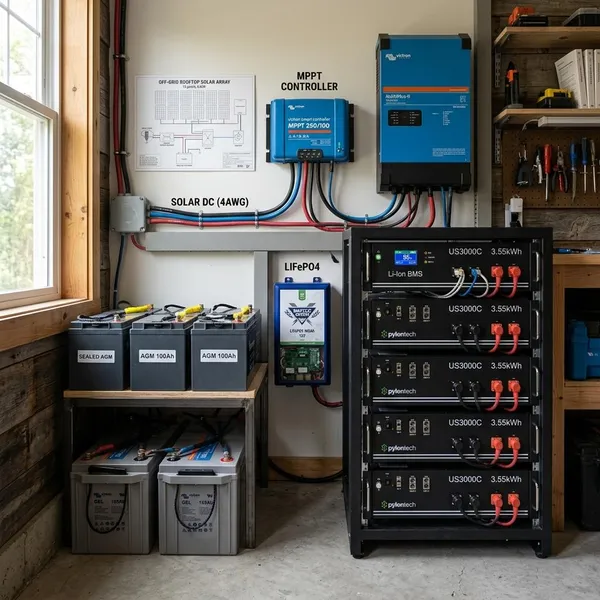
What is the best battery for solar off-grid systems?
For most off-grid solar setups, start by deciding how often the battery will cycle. A full-time home that charges and discharges every day should be judged very differently from a weekend shed that only powers lights and a phone charger.
LiFePO4 batteries fit most off-grid users
LiFePO4, or lithium iron phosphate, is the strongest all-around choice for many off-grid homes, cabins, and RVs. It handles frequent cycling well, gives a higher usable share of its rated capacity, and normally requires far less attention than lead-acid batteries.
The practical benefit is not just “better technology.” If clouds reduce solar production for a day, a LiFePO4 bank gives you more usable stored energy before you need to cut loads or start a generator. That matters for refrigeration, lights, internet equipment, pumps, and other everyday essentials.
AGM batteries fit simple backup systems
AGM batteries are sealed lead-acid batteries that suit people who want a familiar, low-maintenance option without moving into lithium pricing. They are often reasonable for a small shed, a basic backup system, or a cabin that is used lightly.
They are less appealing for heavy daily cycling. If an AGM bank is deeply discharged again and again, it can age quickly, so it works best when loads are modest and the battery is sized with some margin.
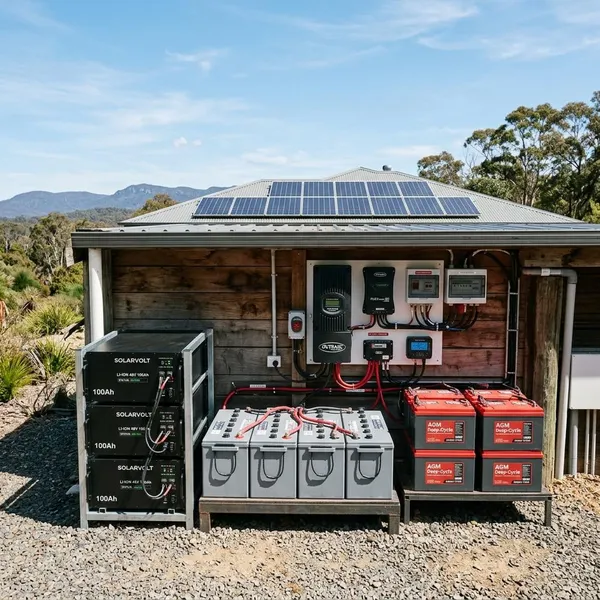
Which battery types work for off-grid solar?
The main battery types used for off-grid solar are LiFePO4, AGM, gel, and flooded lead-acid. They can all store solar power, but they differ sharply in usable capacity, maintenance, charging behavior, weight, and long-term cost.
| Battery type | Best fit | Main caution |
|---|---|---|
| LiFePO4 | Daily use, homes, RVs, long-term systems | Higher upfront cost and charging setup must be correct |
| AGM | Light use, backup, simple cabins | Shorter life if deeply discharged often |
| Gel | Stable low-to-moderate deep-cycle use | Sensitive to incorrect charging voltage |
| Flooded lead-acid | Budget systems with hands-on maintenance | Needs watering, ventilation, and regular checks |
LiFePO4 batteries provide long cycle life
LiFePO4 batteries are known for handling many charge and discharge cycles when used within manufacturer limits. That makes them especially useful when the battery bank works every night and recharges every day.
They also stay lighter and more compact than lead-acid banks with similar usable energy. In a fixed home that may simply make installation easier; in an RV or van, it can be the difference between a practical setup and one that eats too much payload.
AGM batteries provide simple maintenance
AGM’s biggest advantage is simplicity. There is no watering, no exposed liquid electrolyte to check, and less routine mess than flooded lead-acid.
A good AGM scenario is a seasonal cabin where the loads are predictable: LED lights, device charging, maybe a small pump. It becomes less attractive if you expect to run an inverter hard every day or regularly drain the bank deeply.
Gel batteries provide stable deep-cycle power
Gel batteries can provide steady deep-cycle performance in systems designed around their charging needs. They are sealed and maintenance-friendly, which is useful in certain backup, marine, telecom, or low-to-moderate power setups.
The catch is charging sensitivity. A gel battery can be damaged by the wrong charge profile, so it is not a battery to pair casually with a controller that only has broad preset modes.
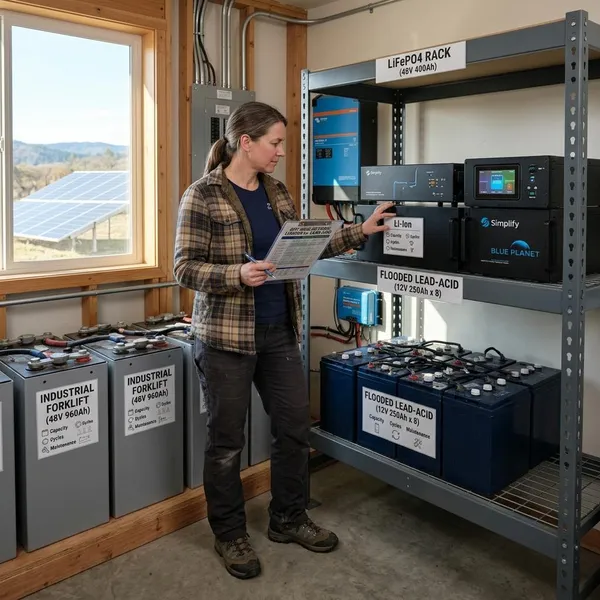
Which off-grid battery fits your needs?
The right battery depends less on the label and more on the way you live with the system. Daily use, seasonal storage, mobile travel, and cold-weather charging all push the decision in different directions.
Full-time homes need long-life batteries
A full-time off-grid home should prioritize cycle life, usable capacity, and dependable charging. LiFePO4 is usually the better choice here because the battery bank is not a backup accessory; it is part of daily life.
For a year-round home, avoid sizing around perfect sunny days. Plan for overnight use, normal evening loads, and some low-sun margin, especially if you rely on refrigeration, water pumping, internet equipment, or an inverter for larger appliances.
Cabins need reliable seasonal storage
Cabins vary a lot. A summer weekend cabin with lights and phone charging may do fine with AGM, while a cabin with refrigeration, security devices, and longer stays is usually better served by LiFePO4.
Storage behavior matters because cabins often sit unused. Before buying, check how the battery should be stored, whether it can sit safely between visits, and whether the solar controller will maintain it properly without overcharging or leaving it undercharged.
RVs need lightweight flexible batteries
RVs, vans, and trailers benefit from LiFePO4 because weight and space matter. A lighter battery bank is easier to secure, leaves more payload for water and gear, and usually gives more usable energy in a smaller footprint.
AGM can still be acceptable for a low-cost RV that only runs lights, fans, and small electronics. If you boondock often, use an inverter, or charge from solar, alternator, and shore power, lithium’s faster and more efficient charging becomes much more noticeable.
What should you check before buying an off-grid battery?
Before comparing brands, check capacity, usable depth of discharge, cycle life, and compatibility. These four points decide whether the battery will actually support your loads, last long enough to justify its cost, and work with the equipment you already have.
Battery capacity affects stored energy
Battery capacity tells you how much energy the bank can store, usually shown in kilowatt-hours or amp-hours. The useful starting point is your daily energy use, not the biggest battery you can afford.
- List the loads you need: refrigerator, lights, pump, router, fans, tools, or appliances.
- Estimate how many hours each one runs per day.
- Convert that into daily watt-hours or kilowatt-hours.
- Add backup time for nights and low-sun days.
A cabin with LED lights and a small pump may need a modest bank. A full-time home with refrigeration, laundry, and constant background loads needs a much larger reserve.
Depth of discharge affects usable power
Depth of discharge is the share of the battery you can use before recharging. This is why two batteries with the same rated capacity may feel very different in real life.
A 10 kWh lithium bank may provide far more usable daily energy than a 10 kWh lead-acid bank if the lead-acid system needs shallower discharge to preserve lifespan. When comparing prices, compare usable energy, not just the number printed on the case.
Cycle life affects replacement costs
Cycle life matters most when the system runs every day. A battery used only for emergency backup may age slowly, but a full-time off-grid home can put the bank through hundreds of cycles each year.
This is where a higher-priced LiFePO4 battery can become the cheaper long-term choice. If you would otherwise replace lead-acid batteries more often, the lower upfront price may not be the real bargain.
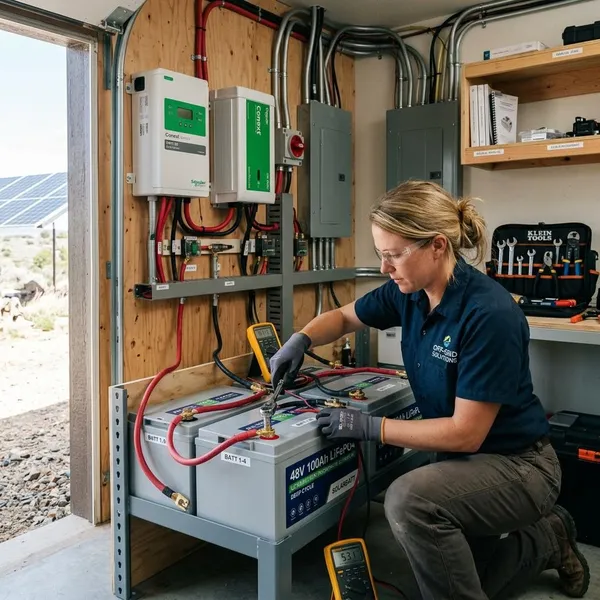
How do you install an off-grid solar battery?
Installing an off-grid solar battery is mainly about matching the equipment and protecting the battery from conditions that shorten its life. If you are not comfortable with DC wiring, fusing, and inverter setup, it is safer to involve a qualified installer.
Match batteries with the inverter
The battery bank and inverter must match in voltage and operating range. A 48V inverter, for example, needs a battery bank designed for that system voltage, and the battery must be able to support the inverter’s expected loads.
Surge loads are easy to underestimate. A pump, power tool, or appliance may start with a higher draw than it uses while running, so capacity alone does not prove the system will work smoothly.
Match charging settings with the controller
The charge controller should be programmed for the battery manufacturer’s recommended charging values. Bulk, absorption, float, low-voltage cutoffs, and temperature behavior can all affect battery life.
Generic presets are not always close enough, especially for gel and lithium batteries. If the controller cannot be adjusted properly, the battery may never perform as expected even if the rest of the system is well sized.
Conclusion
Choose LiFePO4 if your system will be used often and you want the best balance of usable power, lifespan, and low maintenance. Choose AGM for lighter backup or simple seasonal use, and only choose flooded lead-acid when the lower purchase price is worth the added care. The smartest purchase is the battery that matches your daily loads, charging equipment, climate, and maintenance habits—not simply the one with the biggest capacity label or lowest price.