
How Do Graphene and Solid-State Batteries Differ?
Compare graphene and solid-state batteries for EV range, charging speed, safety, lifespan, and production readiness to choose the right technology.
Graphene and solid-state batteries are often compared as if they are rival chemistries, but they usually describe different things. Graphene is normally an added material that can improve parts of a battery, while solid-state refers to replacing the liquid electrolyte with a solid one. If you are judging a graphene battery vs solid state battery claim, check the actual chemistry, tested performance, and whether it is being made at real scale before trusting the headline.
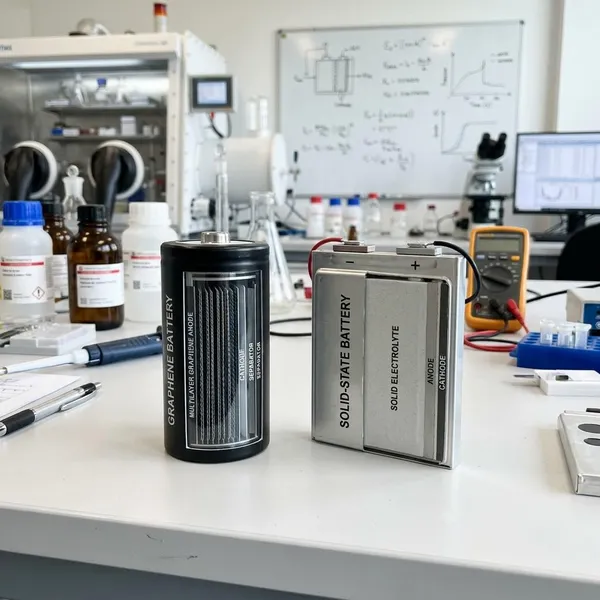
What do "graphene" and "solid-state" actually mean?
The two labels point to different parts of the battery. That is why a direct comparison can get confusing quickly: one term is usually about a material, and the other is about cell design.
Graphene describes a material used in battery components
Graphene is a very thin carbon material known for strong conductivity and heat-spreading potential. In batteries, it is most often used in electrodes, conductive coatings, current collectors, or composite materials rather than as the whole battery chemistry.
That matters for everyday claims. A "graphene battery" in a power bank, scooter, or EV announcement may still be a lithium-ion battery with graphene added to improve charging behavior, power delivery, or thermal control. The useful question is not "Does it contain graphene?" but "What part of the cell uses it, and what measured benefit does it create?"
Solid-state describes the battery's electrolyte
A solid-state battery uses a solid electrolyte instead of the liquid or gel electrolyte found in most common lithium-ion cells. The electrolyte is the pathway that lets ions move between the anode and cathode during charging and discharging.
The promise is bigger than a small material upgrade: a solid electrolyte may reduce flammability risk and may support higher-energy designs, including some lithium-metal concepts. The difficulty is also bigger. The solid electrolyte has to keep good contact with the electrodes, handle temperature changes, and survive many cycles without cracking or degrading.
The two approaches can be combined
Graphene and solid-state are not mutually exclusive. A battery could use graphene-enhanced electrodes and a solid electrolyte in the same cell.
For a reader comparing products, this is the first common trap to avoid: do not treat the labels as two clean boxes. Graphene is a tool a designer can use inside different battery types. Solid-state is a broader architecture choice that changes how ions move through the cell.
How do graphene and solid-state batteries compare?
A fair comparison should focus on what changes for the user: charging speed, range or runtime, safety, lifespan, cost, and availability. The label alone does not tell you enough, because pack design, cooling, software, manufacturing quality, and the underlying chemistry can matter just as much.
| What you are judging | Graphene-enhanced batteries | Solid-state batteries |
|---|---|---|
| Near-term usefulness | More likely to appear as an improvement to existing lithium-ion products | Still mostly tied to prototypes, pilot lines, or limited early deployments |
| Main practical promise | Better conductivity, faster power delivery, and heat handling | Higher safety potential and possibly higher energy density |
| Main risk in claims | The word "graphene" may be used for a small additive with modest benefit | Lab results may not yet translate into affordable mass production |
Charging speed and power
Graphene can help with charging and power because it may reduce resistance and improve conductivity inside parts of the cell. That can be useful in high-drain situations, such as fast-charging devices, performance tools, scooters, or EV packs where heat and current flow are limiting factors.
Still, a graphene label does not guarantee a dramatic charging jump. A product also needs suitable cell chemistry, thermal design, charging software, and a charger that can safely deliver the claimed power.
Energy density and weight
Solid-state has the stronger long-term story for energy density. If the design safely supports lithium-metal or other high-capacity anodes, it could store more energy for the same size or weight.
Graphene may help indirectly by improving electrode structure or supporting more demanding materials, but it is not a magic shortcut to huge range gains. For a phone accessory or small power bank, faster charging may matter more than maximum energy density. For an EV buyer, pack-level energy density matters more because it affects range, weight, cost, and usable cabin space.
Safety and heat
Solid-state batteries may reduce some fire risks because they remove the flammable liquid electrolyte used in many conventional lithium-ion cells. "Safer" is the right way to think about it, not "fireproof."
Graphene works from another angle. It may help spread heat and reduce hot spots, which can support safer fast charging or high-load use. But safety still depends on the full system: cell quality, separators, pack structure, battery management software, cooling, and protection against damage.
Lifespan and reliability
Graphene-enhanced lithium-ion has a practical advantage here because it builds on battery systems manufacturers already understand. If the graphene improves conductivity or reduces stress in the electrode, it may help cycle life, especially where fast charging would otherwise accelerate wear.
Solid-state batteries may eventually last very well, but reliability is one of the hardest parts to prove. A strong lab demo is not the same as years of daily charging, winter mornings, hot parking lots, potholes, and repeated fast-charge sessions.
Cost and production scale
Graphene enhancements can often fit into existing lithium-ion manufacturing more easily than a full solid-state redesign. That does not make them cheap or simple, but it gives them a shorter path into real products.
Solid-state batteries need new materials, tight process control, and high manufacturing consistency. Early yields and costs can be a serious barrier. For a buyer, this means a modest improvement that is available now may be more relevant than a larger breakthrough that still cannot be produced affordably.
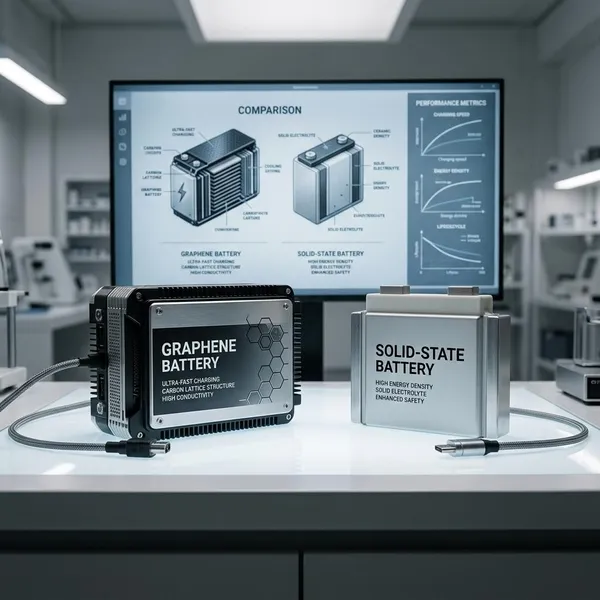
Which approach looks more promising for EVs?
For EVs, the answer depends on the timeframe. If you are choosing a vehicle soon, proven lithium-ion platforms, including possible graphene-related improvements, deserve more attention. If you are watching the next major battery shift, solid-state is the more ambitious technology to track.
Compare tested charging times
Charging claims need context. A headline may use a narrow state-of-charge window, ideal pack temperature, a high-power charger, or a prototype cell rather than a production vehicle.
- For a near-term EV purchase: look for repeated 10–80% charging tests from real vehicles, not only company slides.
- For future technology tracking: watch whether fast charging stays stable after many cycles and across hot and cold conditions.
- For any claim: check whether charging speed tapers sharply after the headline window.
Graphene-enhanced lithium-ion may improve power handling sooner because it adapts familiar systems. Solid-state fast charging could become impressive, but it needs broader proof outside carefully controlled tests.
Compare energy at the cell and pack level
Cell-level numbers can be misleading if you are thinking about EV range. A battery pack also needs cooling, structure, wiring, electronics, modules, and safety protection. Those parts can reduce the advantage shown by an individual cell.
A useful check is to ask whether the claim refers to a material sample, a single cell, a module, or a complete vehicle pack. Solid-state may eventually improve both cell and pack metrics, especially if it reduces cooling or protection needs. Graphene-enhanced cells may offer smaller gains, but even small improvements can matter if they survive the jump into a complete pack.
Check production readiness and cost
Production readiness is where many exciting battery stories slow down. An EV battery has to be made in large volumes, pass safety validation, meet warranty expectations, and stay affordable enough for the vehicle segment.
If you are buying an EV in the next few years, be cautious about paying extra attention to a technology that is not clearly in production. If you are comparing long-term automaker roadmaps, solid-state partnerships are worth watching, but timeline slips are common in advanced battery development.
How can you assess battery claims?
The best filter is simple: identify what the battery actually is, look for independent testing, and check whether it exists beyond samples or pilot production. This keeps you from overvaluing a futuristic label before the product has proved itself.
Identify the actual cell chemistry
Start with the chemistry, not the buzzword. Ask whether the cell is lithium iron phosphate, nickel-based lithium-ion, silicon-enhanced lithium-ion, lithium-metal, sodium-ion, or another design.
- Graphene claim: where is the graphene used, and how much does it change performance?
- Solid-state claim: is the electrolyte fully solid, semi-solid, gel-based, or hybrid?
- EV claim: are the numbers for a cell, module, pack, or production vehicle?
- Consumer device claim: does the charger, cable, and battery management system support the advertised speed?
Look for independently tested results
Independent data carries more weight than a company's best-case number. Look for results from certification labs, automaker validation, university testing, published technical papers, or credible third-party teardown and performance testing.
One practical boundary: be extra cautious when a claim combines very fast charging, very high energy density, long cycle life, low cost, and immediate mass availability all at once. Battery design usually involves trade-offs, so a "no compromise" claim needs stronger proof.
Check whether the product is available at scale
Scale is a reality check. A lab result can be exciting, but mass production reveals whether the company can keep quality consistent, control costs, and support warranties.
- Material result
- Prototype cell
- Pilot production
- Limited commercial launch
- High-volume manufacturing
For a low-risk gadget, you might accept a newer battery claim if reviews and safety certifications are solid. For a high-cost purchase such as an EV or home energy system, wait for stronger evidence: production vehicles, warranty terms, independent tests, and real user data over time.

Conclusion
The practical choice is not really graphene versus solid-state as a slogan. Graphene is more likely to improve familiar lithium-ion batteries in the near term, especially where charging speed, power, and heat matter; solid-state has the bigger long-term upside for EV range and safety, but only if production and durability challenges are solved. Treat tested, available products as more important than impressive labels, and use the chemistry, independent data, and scale of production as your first checks.