
Which Deep Cycle Battery Is Best for Solar?
Discover the best deep cycle battery for solar for homes, RVs, cabins, and backup power.
For most solar power systems, a LiFePO4 deep cycle battery offers the best balance of usable capacity, cycle life, safety, and long-term value. AGM, gel, and flooded lead-acid batteries can still be practical for lower-budget or occasional-use setups, but the right choice depends on your system voltage, daily energy use, charging conditions, and how deeply the battery will be discharged. Focusing on usable amp-hours and expected cycle life is far more reliable than choosing by upfront price alone.
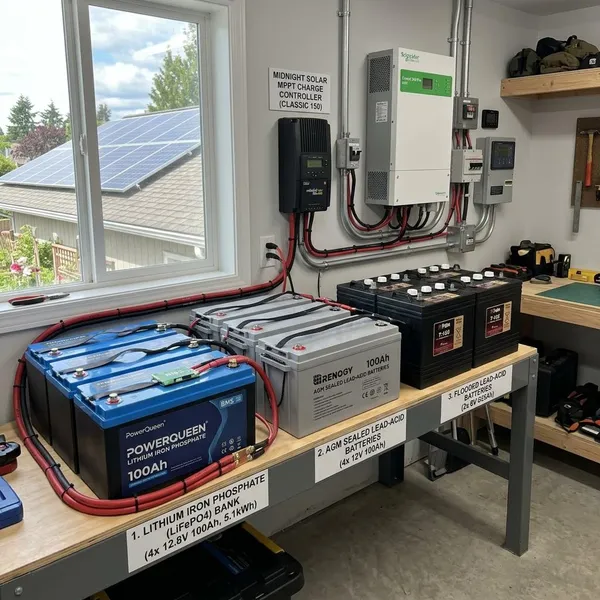
Which battery types work best for solar?
For regular solar storage, LiFePO4 is the strongest all-around option because it gives you more usable energy, longer cycle life, and less maintenance. AGM is a sensible middle ground for moderate use or backup power, while flooded lead-acid is mostly a budget choice for people who do not mind maintenance. Gel batteries are more niche and work best when the system is set up specifically for them.
If you are choosing between batteries, do not compare only amp-hours or price. Compare how much energy you can actually use, how many cycles the battery is likely to handle, whether your charger supports the chemistry, and how much attention the battery will need over time.
| Battery type | Best fit | Main caution |
|---|---|---|
| LiFePO4 | Daily solar use, RVs, cabins, off-grid homes | Higher upfront cost and charging settings must match |
| AGM | Backup power, moderate use, sealed low-maintenance systems | Shorter cycle life if deeply discharged often |
| Gel | Carefully controlled low-to-moderate discharge systems | Sensitive to incorrect charging voltage |
| Flooded lead-acid | Low-cost systems where maintenance is acceptable | Needs watering, ventilation, and more conservative use |
LiFePO4 batteries offer long life and high efficiency
LiFePO4 batteries are often the best choice for daily solar storage because they can usually handle deep cycling better than lead-acid options. Many quality models are rated for thousands of cycles, and they commonly allow a much higher usable depth of discharge than AGM or flooded batteries.
The practical benefit is simple: a 100Ah LiFePO4 battery may deliver far more usable energy than a 100Ah lead-acid battery in normal use. That matters if you are running a fridge overnight, powering an RV for several days, or using a cabin system every weekend. The upfront price is higher, but for frequent cycling, the long-term value is often stronger.
AGM batteries provide reliable power with low maintenance
AGM batteries are a good fit when you want a sealed battery and do not want to deal with watering or acid spills. They are widely available, familiar to many installers, and useful for smaller solar systems, backup loads, RVs, and marine setups.
- Good for occasional use: weekend cabins, short outages, and light backup loads.
- Less ideal for heavy daily cycling: repeated deep discharge can shorten their life.
- Size more conservatively: many AGM systems last longer when not drained too deeply.
Gel batteries suit specific solar applications
Gel batteries can work well in solar systems that use the correct charger settings and moderate discharge rates. They are sealed and low maintenance, but they are less forgiving than AGM or LiFePO4 if the charging voltage is wrong.
I would not usually choose gel as the default battery for a new home solar setup unless there is a clear reason for it, such as replacing batteries in a system already designed for gel chemistry. For most buyers, AGM is easier to source and LiFePO4 gives better long-term performance.
How do you choose the right battery size for solar?
Choose battery size by working backward from your actual energy use, not from a random amp-hour number. The key figure is usable watt-hours: how much energy the battery can safely deliver after voltage, depth of discharge, and battery chemistry are considered.
A simple example helps. A 12V 100Ah battery has about 1,200Wh of rated energy. With LiFePO4, much of that may be usable in normal operation; with lead-acid, you may plan around roughly half if you want better lifespan. That difference can change the size of the battery bank you need.
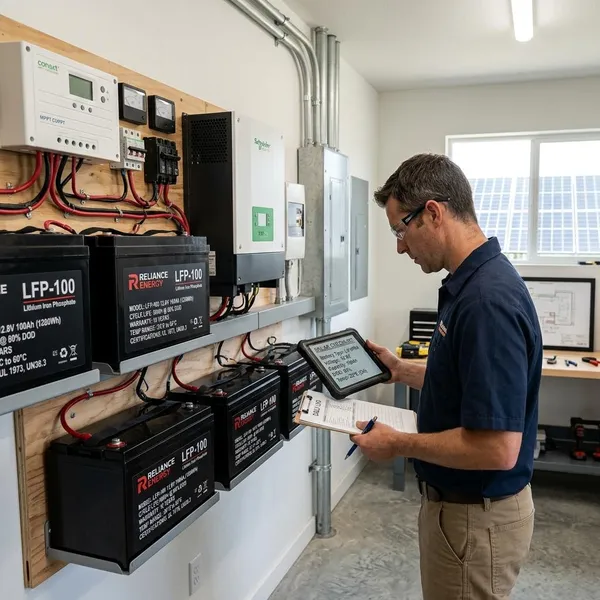
Calculate daily energy use before choosing capacity
List the appliances you actually want to run, then multiply watts by hours of use. A 60W fan running for 8 hours uses 480Wh. A 12W router running all day uses 288Wh. A few small loads can add up faster than expected.
For a light weekend setup, you may only need enough storage for lights, phone charging, and a small fan. For a year-round cabin or off-grid home, include heavier loads such as refrigeration, pumps, internet equipment, and cloudy-day reserve. Those are very different buying decisions.
Match amp-hours with your solar system needs
Amp-hours are useful only when you include voltage. Use this formula:
- Volts × amp-hours = watt-hours
- 12V × 100Ah = about 1,200Wh rated energy
- 24V × 100Ah = about 2,400Wh rated energy
After that, reduce the number to realistic usable energy based on chemistry. Two batteries with the same amp-hour rating can give very different runtimes if one is LiFePO4 and the other is lead-acid.
Consider backup time and depth of discharge
Backup time tells you how long your chosen loads can run. Depth of discharge tells you how much of the battery you should use regularly without shortening its life too much. These two checks prevent one of the most common solar mistakes: buying a battery that looks large on the label but feels small in daily use.
If your overnight loads need 1,000Wh, do not choose a battery that only barely reaches 1,000Wh of usable capacity. Leave some margin for battery aging, colder weather, and days when you use more power than planned.
What should you check before buying a solar battery?
Check compatibility before price. A battery is only useful if it matches your system voltage, charge controller, inverter, installation space, and climate. After that, compare usable capacity, expected cycle life, charging efficiency, warranty terms, and maintenance needs.
The biggest mistake is upgrading one part of the system without checking the rest. For example, replacing lead-acid with lithium can be a smart move, but only if the charge controller and inverter can use the right charging profile and protection settings.
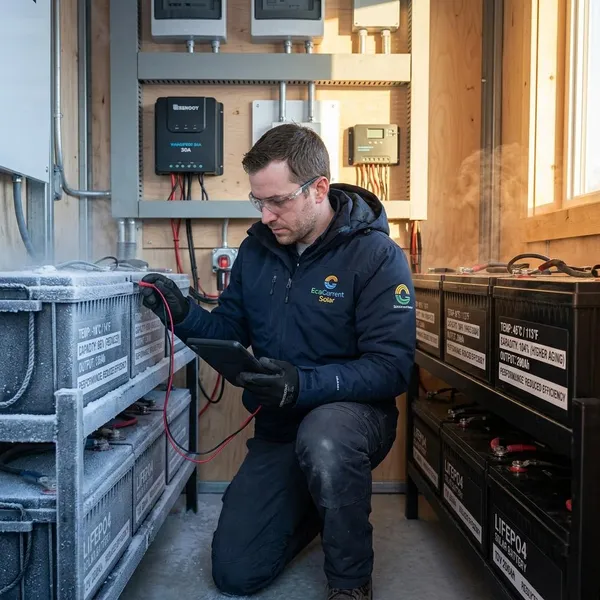
Check voltage for system compatibility
Match the battery bank to the system voltage unless you are redesigning the whole setup. A 12V system needs a 12V battery bank, while larger systems may use 24V or 48V to reduce current and improve efficiency.
Before buying, check three things: the inverter input voltage, the charge controller battery voltage, and the charging profile supported by the equipment. A voltage mismatch or wrong charge setting can cause poor performance, error shutdowns, or equipment damage.
Compare usable capacity and battery lifespan
Usable capacity matters more than the printed rating. A battery with a high amp-hour number may still be a weak choice if you can only use a small portion of that capacity without wearing it out quickly.
- For daily cycling: prioritize cycle life and usable depth of discharge.
- For backup only: upfront cost may matter more, but storage still needs to cover the selected loads.
- For hard-to-access locations: choose longer life and lower maintenance over the cheapest option.
Consider efficiency and charging performance
Efficiency decides how much of your solar production actually comes back out of the battery. This becomes more important when panel space is limited, winter sun is weak, or the system is used every day.
LiFePO4 batteries usually charge faster and waste less energy than lead-acid batteries, but the exact result depends on the battery, charger settings, cable sizing, and system design. If your solar array is already small, a more efficient battery can feel like a real upgrade because less energy is lost between charging and use.
How does temperature affect solar batteries?
Temperature can change battery performance as much as chemistry does. Cold weather can reduce available capacity and charging ability, while heat speeds up aging. If the battery will sit in a shed, RV compartment, garage, or outdoor enclosure, choose with climate in mind from the start.
A battery kept in a stable indoor space usually has an easier life than one exposed to freezing nights or summer heat. Placement, ventilation, shade, and low-temperature protection can matter almost as much as the brand name.
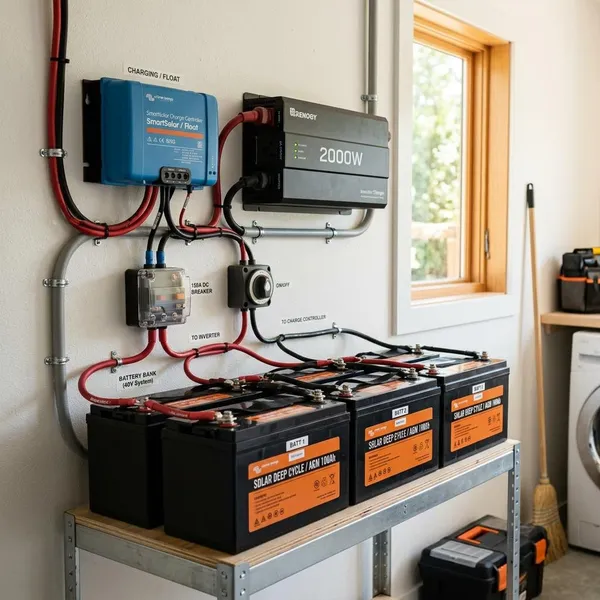
Cold weather reduces charging performance
Cold batteries often accept charge more slowly and may deliver less usable capacity. LiFePO4 batteries need special attention because many should not be charged below freezing unless they have low-temperature protection or internal heating.
For a winter cabin, an outdoor shed, or an RV used in cold weather, look for a battery management system that blocks unsafe charging and consider placing the battery somewhere less exposed. If you cannot keep the battery above its allowed charging range, do not assume "solar charging will take care of it."
Heat shortens battery lifespan
Heat ages batteries faster. Lead-acid batteries may lose water and corrode more quickly, while lithium batteries can also degrade sooner when they spend long periods in high temperatures.
- Avoid direct sun: use shade or an indoor location where possible.
- Keep distance from hot equipment: inverters and chargers can add heat.
- Allow airflow: tight sealed boxes can trap heat and shorten battery life.
Battery type should match your climate
In mild indoor conditions, most battery types can work if they are sized and charged correctly. In cold climates, lithium with low-temperature charging protection is often worth paying for. In very hot spaces, long cycle life helps, but installation quality becomes critical.
If your system is only used in summer, an AGM battery may be perfectly reasonable for light loads. If you rely on solar year-round for an off-grid home, climate tolerance and battery protection should move near the top of the buying list.
Conclusion
For most daily-use solar systems, LiFePO4 is the best long-term pick because it gives more usable capacity, better efficiency, and less maintenance, but it is still not a free pass to ignore sizing and compatibility. AGM can be a practical choice for lighter use or backup power, and flooded lead-acid only makes sense when low upfront cost is worth the extra maintenance. Choose the battery that fits your real loads, your climate, and your equipment first; price should come after those checks, not before them.