
Is a Deep Cycle Battery or Power Station Better?
Compare deep cycle battery vs power station options by cost, runtime, setup, and solar use so you can choose the right fit.
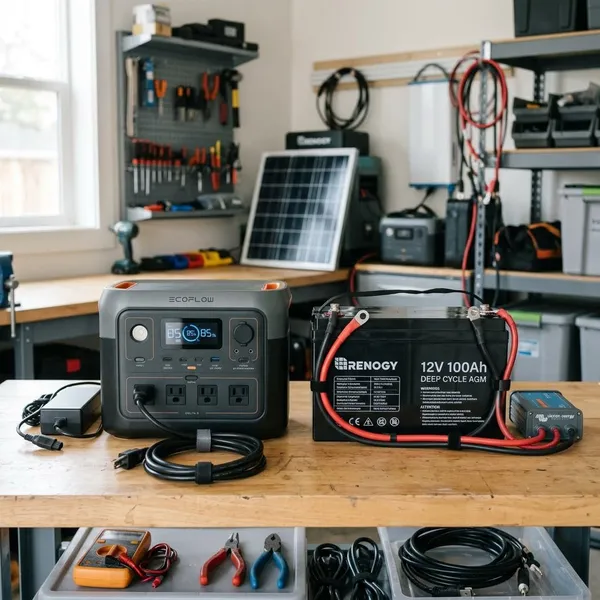
If you want the easiest portable power for a trip or short outage, choose a power station. If you want a larger fixed system that can be expanded, repaired, and matched to your exact loads, a deep cycle battery setup usually makes more sense. The real choice is not just deep cycle battery vs power station; it is whether you want a finished appliance or a system you are willing to build.
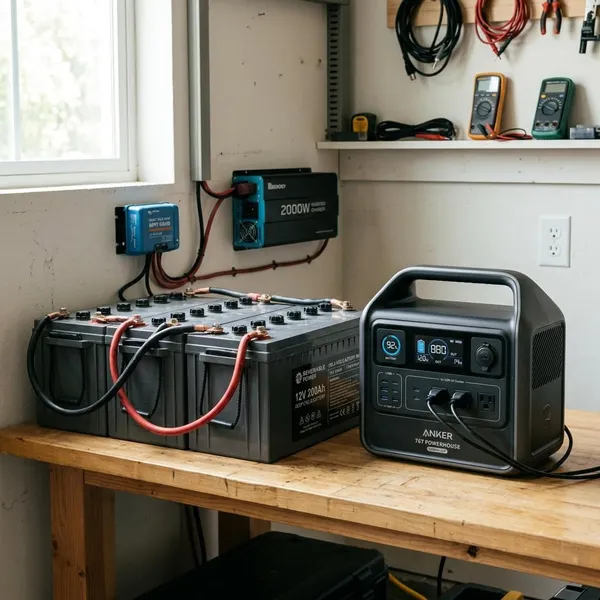
What is the difference between a battery and a power station?
A battery is only the storage part. A power station is a ready-made box that includes the battery plus the electronics needed to charge it and run devices from it. That difference sounds small, but it changes the cost, setup time, portability, and how much control you have later.
A deep cycle battery is designed to be discharged and recharged repeatedly. It is made for steady energy use, unlike a car starting battery, which is built to deliver a short burst of current to start an engine.
You will see deep cycle batteries in RVs, boats, solar sheds, cabins, trolling motors, and backup systems. The battery itself does not give you wall outlets, USB ports, or solar input controls; it only stores DC power until the rest of the system uses it.
Deep cycle does not mean one specific chemistry. Flooded lead-acid, AGM, gel, and lithium iron phosphate batteries can all be deep cycle designs, though they behave differently in weight, usable capacity, maintenance, and cycle life.
A power station combines a battery with outlets and charging controls
A portable power station is closer to a small energy appliance. It usually includes a battery, inverter, charge controller, battery management system, screen, AC outlets, USB ports, and 12V outputs in one enclosure.
You can charge it from the wall, put it in the car, take it camping, and plug in a laptop or light without choosing cables, fuses, an inverter, or a separate charger.
A battery setup needs components chosen to match
A standalone battery becomes useful only after the other parts are matched to it. For a practical system, you may need an inverter, charger, solar charge controller, fuses, disconnects, cables, mounting hardware, and a battery monitor.
- Battery: stores the energy.
- Inverter: turns DC battery power into AC power for household-style appliances.
- Charger or solar controller: charges the battery safely from wall power, a vehicle, or solar panels.
- Protection hardware: helps reduce risk from shorts, overloads, and poor wiring.
- Monitoring: shows state of charge and helps prevent over-discharge.
It is flexible, but a mismatched inverter, undersized wire, or missing fuse can make the setup unreliable or unsafe.
How do the complete setups compare?
Usable capacity and runtime
Start with usable watt-hours, not just amp-hours or the biggest number on the product page. A 12V 100Ah battery is roughly around 1,200Wh to 1,280Wh nominal, depending on its actual voltage, but you may not want to use all of that capacity in daily operation.
| Setup detail | Why it matters | Practical check |
|---|---|---|
| Battery chemistry | Lead-acid often has less routine usable capacity than lithium | Check the recommended depth of discharge |
| Inverter losses | AC appliances use extra energy during conversion | Allow a buffer instead of calculating runtime to the last minute |
| Real appliance draw | Labels and actual use can differ | Use a watt meter for devices you rely on often |
For a quick estimate, divide usable watt-hours by the device's watt draw. A system with about 1,000Wh usable energy might run a 100W device for roughly 10 hours before losses and safety buffer. That same system will feel much smaller if you run a heater, kettle, or microwave.
AC output and available ports
Power stations usually win for everyday convenience because the ports are already built in. Phones, laptops, lights, camera batteries, routers, and small coolers can often plug in with no extra parts.
A battery alone cannot run AC appliances. You need an inverter, and that inverter must match the job. A small inverter may be fine for a laptop charger, but not for a coffee maker, microwave, hair dryer, or power tool with a high startup load.
- Continuous watts: the power it can supply steadily.
- Surge watts: the short burst needed by some motors and compressors.
- Pure sine wave output: usually the safer choice for sensitive electronics.
- USB-C PD rating: important for laptops and tablets.
- 12V regulation: useful for fridges and gear that dislikes voltage dips.
Charging and solar compatibility
With a power station, solar charging is usually simple but limited by the unit's input range. You need panels that match the allowed voltage, wattage, and connector style. If the solar input limit is low, adding more panels may not help much.
A deep cycle battery setup needs a separate charge controller, but that gives you more control over panel layout, charging current, and future upgrades. This matters more for a cabin, RV roof array, or daily off-grid use than for a weekend campsite.
Do not connect solar panels straight to a battery unless the system is specifically designed for that. Solar output changes constantly, and the battery needs proper charging control.
Portability and setup
For temporary use, the power station is hard to beat. Charge it at home, carry it to the campsite, plug in your devices, and put it away when the trip is over.
A custom battery setup can be moved, but once you add an inverter, cables, fuses, charger, box, and mounting hardware, it becomes less grab-and-go. That is fine in a van or trailer where the system stays installed, but annoying if you only need backup power twice a year.
If the power source needs to move between the house, car, tent, garage, and backyard, lean toward a power station. If it will live in one place and feed the same loads repeatedly, a battery system becomes more attractive.
Expansion and maintenance
Expansion is where a battery system often has the advantage. You can add more storage, choose a larger inverter, install more solar, or replace individual parts as your needs change.
Power stations are mixed. Some accept expansion batteries; others are closed units. If your needs grow beyond the built-in capacity or inverter size, you may have to buy a second unit or replace the first one.
Maintenance depends heavily on chemistry. Flooded lead-acid batteries may need ventilation, correct charging, and water checks. AGM is simpler but still sensitive to charging habits. LiFePO4 is usually lower maintenance, but it still needs a proper charger, temperature awareness, and a suitable battery management system.
Total system cost
A power station may look expensive until you remember what is included: inverter, charger, solar input electronics, display, ports, enclosure, and safety management. A bare battery price does not include any of that.
When pricing a deep cycle battery setup, count the full system:
- Battery or batteries
- Inverter sized for your highest load
- AC charger, DC-DC charger, or solar charge controller
- Cables, fuses, disconnects, terminals, and mounting hardware
- Battery monitor or shunt if accurate state of charge matters
- Tools, enclosure, and installation time
Small DIY systems do not always save much after the missing parts are added. Larger permanent systems often become better value because the battery bank, inverter, and solar array can be sized separately instead of being locked inside one portable unit.
Which option fits your needs?
The easiest way to choose is to match the setup to the situation. A weekend camper, a full-time van build, and a home backup plan do not need the same kind of power system.
For camping, festivals, tailgating, and weekend travel, a power station is usually the cleaner choice. It is quiet, portable, simple to recharge, and friendly for people who do not want a wiring project before a trip.
Typical light-use loads include phones, cameras, LED lights, a laptop, a small fan, or a compact fridge. If that is your world, the convenience is worth a lot.
A deep cycle battery can still work well for a trailer, truck bed setup, or fishing trip where you already have 12V gear. It is less appealing if you need AC outlets and USB ports but have not bought the supporting parts yet.
RVs and van conversions
An RV or van conversion often favors a custom battery system because the power needs are more permanent. You may want roof solar, alternator charging, 12V appliances, an inverter, and fixed wiring that stays in place all year.
Home backup during outages
For short outages, a power station is often the practical pick. Keep it charged, store it indoors, and use it for a modem, phones, lamps, medical support devices, or a small fridge if the unit is rated for the load.
For longer outages, the question changes from "Can I keep a few essentials on?" to "How many watt-hours do I need per day, and how will I recharge?" A larger battery bank with solar or a proper charging plan may be better if outages are frequent, long, or tied to storms that also limit sunlight.
Off-grid solar systems
For serious off-grid solar, a deep cycle battery setup is usually the stronger path. It lets you size storage, inverter capacity, solar input, and charging hardware around daily use instead of accepting the limits of one portable box.
A power station can still make sense for a shed, small cabin, camera system, remote desk, or seasonal weekend spot. Once the use becomes daily, year-round, or tied to essential loads, a custom system is usually easier to service and expand.
The important shift is planning for bad days, not average days. If cloudy weather, winter use, refrigeration, or medical equipment is involved, treat the system as infrastructure rather than a gadget.
How to make the final choice
Before comparing brands, check your own loads.
Calculate your daily energy use
Write down each device, its watt draw, and how long you expect to use it. Multiply watts by hours to estimate watt-hours.
For example, a 50W laptop charger used for 3 hours is about 150Wh. A 10W light used for 5 hours is about 50Wh. A fridge is trickier because it cycles on and off, so real-world testing or manufacturer energy data is more useful than guessing from the peak wattage.
Check appliance power requirements
Capacity tells you how long a system may run. Output rating tells you whether it can run the appliance at all.
This is where buyers often overspend or underbuy. A small power station may charge laptops beautifully but fail with a coffee maker. A large battery may store plenty of energy but still be useless for AC appliances if the inverter is too small.
- Low-risk loads: phones, lights, tablets, cameras, small fans.
- Check carefully: fridges, CPAP machines, routers, laptops, pumps.
- High-draw loads: microwaves, kettles, heaters, hair dryers, power tools.
Price the full battery system
Do not compare a raw battery against a power station sitting on a store shelf. Compare finished systems that can do the same job.
If the deep cycle battery setup needs an inverter, charger, solar controller, fuses, cables, enclosure, monitor, and mounting parts, include them. If you are not comfortable installing those parts, also consider the value of buying something that works immediately.
A small occasional-use setup often favors the power station. A larger fixed setup, especially one with solar and room to grow, may justify the extra planning of a custom battery system.
Allow for future expansion
Think one step beyond the first purchase. If you might add a fridge, extra solar panels, longer backup time, or heavier appliances, expansion matters from day one.
With a power station, check whether the model supports add-on batteries and what the maximum solar input is. With a battery system, check whether your inverter, charge controller, wiring, and battery chemistry can support the larger setup you may want later.
If you are only covering a few weekend trips, do not overbuild. If you are building a van, cabin, or outage plan you will rely on regularly, leave yourself room to grow.
Conclusion
Choose a power station when convenience, portability, and fast setup matter more than long-term customization. Choose a deep cycle battery system when the setup will be fixed, expanded, repaired, or sized around heavier daily use. The safest buying decision is to calculate your watt-hours first, check your highest appliance load second, and only then compare prices.