
Can a 2000W Power Station Run Your Refrigerator?
Find the best 2000 watt power station for refrigerator backup, including sizing, runtime, surge needs, and charging tips.
A 2000W-class solar generator is a practical backup choice for most household refrigerators because it can handle the brief compressor startup surge while remaining portable enough for home storage and emergency use. The key is to match the generator to your fridge's real power needs: its starting watts, daily energy consumption, and the number of hours or days you want it to keep running during an outage.
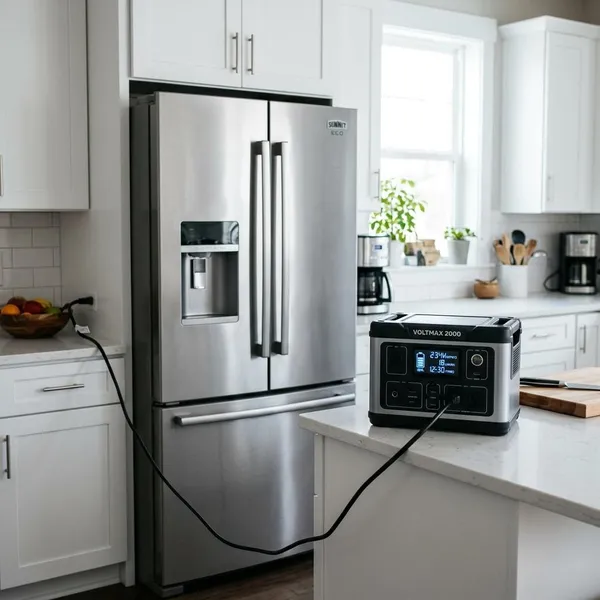
Can a solar generator run a refrigerator?
A solar generator can run most refrigerators with enough power
Most standard refrigerators are not huge power users once they are running. Many use roughly 100 to 250 watts while actively cooling, though older models, large French-door units, garage fridges, and refrigerators with ice makers can use more.
The useful check is not "Will a solar generator run a fridge?" but "Will this specific unit run my fridge in my actual conditions?" A kitchen refrigerator in a cool room is easier to support than the same fridge sitting in a hot garage during summer.
A strong inverter handles refrigerator startup power
The compressor startup surge is the part that catches people out. A refrigerator that runs at 180 watts may briefly need several hundred watts when it starts. Some older appliances can spike higher, so sizing too close to the running wattage is risky.
- Choose pure sine wave AC output for refrigerator motors and household electronics.
- Leave surge headroom instead of buying a unit that barely meets the expected load.
- Avoid stacking heavy loads such as kettles, heaters, or microwaves while the fridge is cycling.
A larger battery provides longer backup time
Battery capacity is what turns "it starts" into "it stays cold." A small power station may start a refrigerator but run out quickly, while a larger battery gives you time to get through a short blackout without constantly watching the display.
For short apartment outages, a smaller battery may be acceptable if the fridge is efficient and you keep the door closed. For storm-prone areas or a full fridge/freezer you cannot afford to lose, extra capacity is not a luxury; it is the safety margin.
Which solar generator is best for refrigerator backup?
Best overall solar generator for most refrigerators
For a typical kitchen refrigerator, the best overall choice is usually a 2000W-class unit with pure sine wave output, strong surge handling, and enough battery capacity to cover at least your expected outage window. This size can often run the fridge while still leaving room for small essentials such as a router, LED lights, and phone charging.
This is the category to focus on if you want one unit for home backup rather than a tiny emergency battery or a large whole-house system. It is also the most forgiving option if you are unsure about the exact startup surge of your refrigerator.
Best budget solar generator for short outages
If your outages are usually brief, a budget setup can work as long as you do not compromise on surge capability. Lower price should usually mean less runtime, not an inverter that is too weak to start the fridge.
A sensible budget scenario is a compact or efficient refrigerator, a few hours of backup, and no plan to run other high-draw appliances at the same time. It is not the right place to save money if you have an older garage fridge, frequent summer outages, or a freezer full of food.
Best high-capacity solar generator for long backup
Long backup calls for more battery, not just more watts. Once the refrigerator is running reliably, daily energy use becomes the real limit. A high-capacity or expandable system makes sense when outages may last overnight, through a storm, or across several cloudy days.
| Backup situation | Better choice | Why it matters |
|---|---|---|
| Short neighborhood outage | Moderate battery, strong inverter | Startup reliability matters more than multi-day storage |
| Overnight storm backup | 2000Wh-class or larger battery | Gives useful margin after inverter losses |
| Fridge plus freezer | Expandable high-capacity system | Combined daily energy use adds up quickly |
| Multi-day outage risk | Large battery plus meaningful solar input | Recharging becomes part of the backup plan |
Best portable solar generator for RV and outdoor use
RV and outdoor use changes the priorities. Weight, handles, charging from a vehicle, and quiet operation may matter as much as raw capacity. A portable 2000W-class unit can be a good fit if you want to run a compact fridge, charge electronics, and avoid fuel storage at campsites.
For weekend trips, you may care more about easy lifting and fast recharging. For longer RV stays, solar input and battery chemistry become more important because the power station is being used repeatedly, not just kept for emergencies.
How much power does a refrigerator need?
Running watts determine normal power use
Running watts are the power used while the compressor is actively cooling. Many household refrigerators fall somewhere around 100 to 250 running watts, but that is only a rough range. Room temperature, age, door seals, and fridge size all affect the real number.
A power station with a 2000W inverter usually has plenty of room for the running load of a refrigerator plus small essentials. The warning is to avoid adding heat-producing appliances. A coffee maker or microwave can use far more power than the fridge and may push the system past its limit.
Startup surge determines inverter requirements
Startup surge is short, but it decides whether the refrigerator starts smoothly. If the inverter cannot handle that brief spike, the power station may shut down even though the fridge's running watts look low.
When the exact surge number is unknown, use margin. Do not buy a unit that only barely exceeds the fridge's running wattage. A stronger inverter is especially useful for older refrigerators, garage refrigerators, and setups where another small device may already be plugged in.
Daily energy use determines battery capacity
Daily energy use is usually listed as annual kWh on the refrigerator label or energy guide. Divide the annual kWh by 365, then multiply by 1,000 to estimate daily watt-hours. For example, 438 kWh per year is about 1,200Wh per day before considering power station losses.
- Find the annual kWh rating on the fridge label or manual.
- Estimate daily Wh by dividing by 365 and multiplying by 1,000.
- Compare with usable capacity, not just the advertised battery size.
- Add a buffer for hot weather, door openings, and inverter losses.
A plug-in energy meter gives a better answer if you can measure the fridge for a few days. That is the most practical option when you are buying backup power for a specific appliance rather than guessing from averages.
What size solar generator do you need for a refrigerator?
Small generators fit mini fridges and compact cooling
Small solar generators are best for mini fridges, beverage coolers, dorm refrigerators, and short-term cooling. They are easy to move and often enough for light use, but the small battery can disappear faster than expected.
This size makes sense for occasional use, such as keeping drinks cold during a short outage or powering a compact fridge on a day trip. It is not the best choice for protecting a full grocery load overnight unless you have measured the appliance and know the runtime is enough.
Medium generators support standard home refrigerators
Medium generators are the sweet spot for many standard home refrigerators. This is where the best 2000 watt power station category becomes useful: enough inverter strength for most fridge startups, enough capacity for meaningful backup, and still reasonable portability.
Choose this class if you want one practical unit for short power cuts, overnight fridge protection, and occasional RV or outdoor use. It is also a better choice than a tiny unit if you do not know the exact surge requirement of your refrigerator.
Large generators run refrigerators and freezers
Large generators are the better fit when you need to run both a refrigerator and a freezer, support longer outages, or add more household essentials. The combined startup and daily energy use can be much higher than a single fridge, so the extra margin matters.
- Choose larger capacity if food storage is a high priority.
- Look for expansion support if outages are frequent in your area.
- Consider LiFePO4 batteries for regular use and longer cycle life.
If you only need backup once or twice a year, a medium unit may be enough. If you live with repeated storm outages or rely on a chest freezer, stepping up is usually the more comfortable decision.
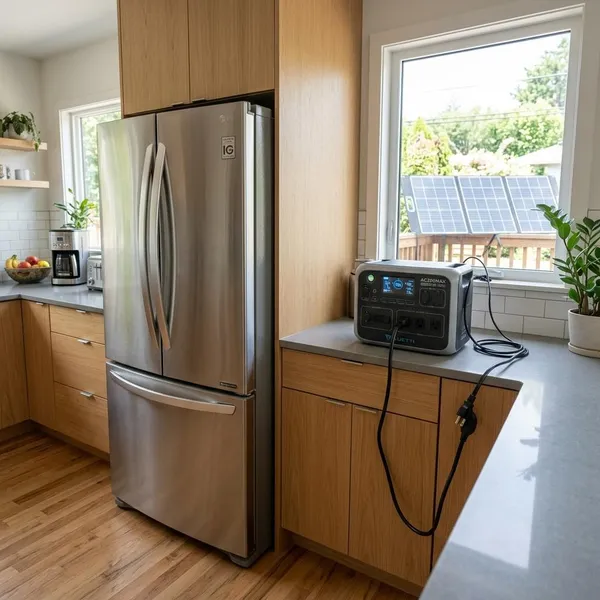
How long can a solar generator run a refrigerator?
Battery capacity determines backup runtime
Start with usable capacity. A power station rated at 2,000Wh will deliver less than that to AC appliances because the inverter uses some energy during conversion. If the usable amount is around 1,700 to 1,800Wh and your fridge averages 100 watts over time, the rough runtime would be about 17 to 18 hours.
That estimate is only a planning number. It gets shorter with heat, frequent door openings, poor seals, or extra devices plugged into the same station.
Refrigerator usage affects daily energy consumption
How you use the fridge during an outage can add hours without buying anything. Keep the door closed, avoid loading warm food, and do not spend time browsing the shelves. A fuller fridge usually holds temperature better than an almost empty one, as long as air can still circulate.
Summer outages are the harder case. A garage fridge in hot weather may cycle far more often than a kitchen fridge in a mild room, so use a bigger buffer if that is your setup.
Extra capacity provides longer outage protection
Extra capacity is most valuable when the outage lasts longer than expected. It gives you margin for nighttime use, cloudy weather, higher fridge demand, and small essentials you forgot to include in your first estimate.
Solar panels can extend runtime, but they should not be treated as magic backup. Panel output depends on sun, placement, weather, and the power station's solar input limit. For multi-day protection, plan for both stored battery capacity and realistic daily recharging.
Conclusion
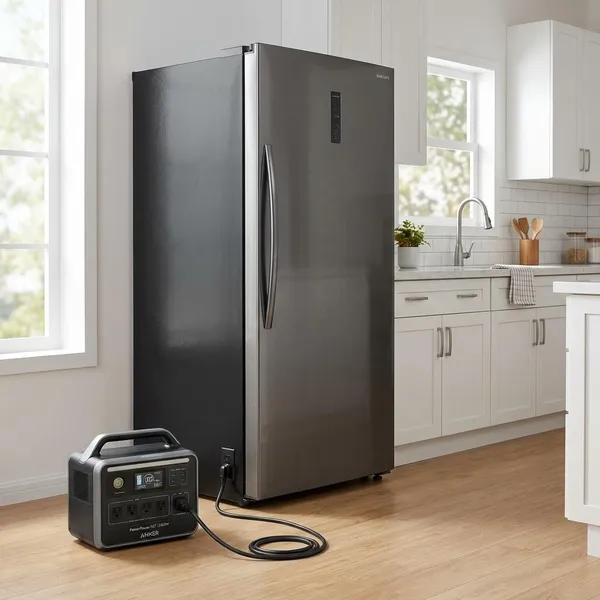
The best choice is the unit that starts your refrigerator without strain and has enough usable battery for the outage you are actually planning for. A 2000W-class power station is a strong fit for many homes, but the smarter buy is the one matched to your fridge label, your runtime goal, and your real conditions, especially if heat, a freezer, or frequent outages are part of the picture.