
Best 12 Volt Solar Battery Charger for Cars, RVs, Boats, and Storage
Find the best 12 volt solar battery charger for cars, RVs, boats, and storage. Learn wattage, controllers, and setup tips.
A good 12-volt solar battery charger should match how you use the battery: light maintenance for a stored car or motorcycle, or higher-output charging for an RV, trailer, boat, or off-grid setup. The key is choosing enough panel wattage, a compatible charge controller, and the right connection method for your battery type. Before buying, check the battery's chemistry, capacity, standby drain, and how much direct sunlight the panel will receive each day.
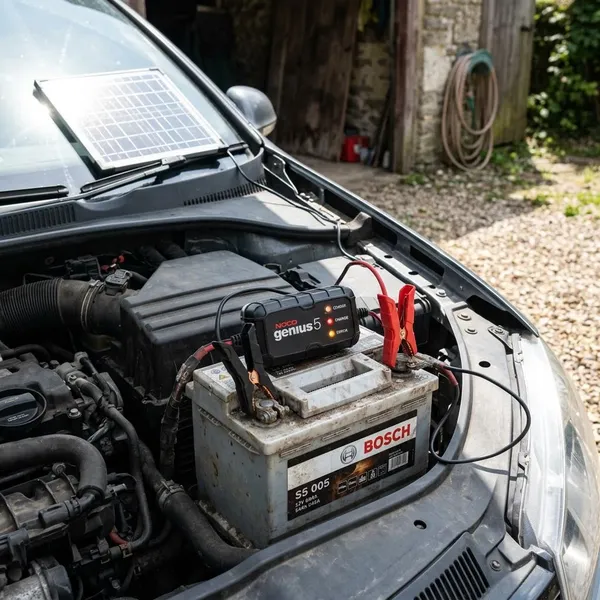
How do you choose a 12V solar battery charger?
Choose a 12V solar battery charger by matching three things: the amount of power your battery loses while sitting, the battery chemistry, and the type of charge controller included. Wattage gets most of the attention, but a slightly larger panel with poor regulation is not always better than a smaller smart maintainer.
A parked weekend car with a healthy battery has very different needs from a travel trailer with detectors, memory circuits, and a battery that sits outdoors all winter. If you are not sure where to start, choose the safest match first: compatible battery type, regulated charging, then enough panel size for your storage conditions.
Choose the right wattage for your battery needs
For simple maintenance, 5W to 10W can be enough for motorcycles, small equipment, and some stored cars in good sunlight. A car with alarms, trackers, weak winter sun, or an older battery is usually better served by 15W to 30W. RVs, trailers, and boats often need 25W to 100W because they tend to have larger batteries and more background electrical loads.
| Use case | Practical wattage range | Best fit |
|---|---|---|
| Motorcycle, ATV, lawn tractor | 5W to 10W | Battery maintenance during storage |
| Stored car with light standby drain | 10W to 20W | Keeping a healthy battery topped up |
| Car in poor sun or long storage | 15W to 30W | More margin for real-world losses |
| RV, trailer, boat, larger battery | 25W to 100W | Maintenance plus slower recovery support |
Match the charger with your battery type
Battery compatibility is not a detail to skip. Many basic solar maintainers are made for lead-acid batteries, while lithium batteries, especially LiFePO4, usually need a controller with a lithium charging profile.
- Flooded lead-acid: common in many older cars and utility batteries.
- AGM: common in modern vehicles, motorcycles, and powersport batteries.
- Gel: needs careful voltage control, so vague compatibility claims are a red flag.
- Lithium: use only if the charger or controller clearly supports it.
Select the right controller for charging efficiency
A controller regulates charging so the battery is not pushed too hard once it is full. For a small car maintainer, a basic smart PWM controller is usually fine. For a larger RV, boat, or trailer setup, MPPT can be worth considering because it can make better use of limited or changing sunlight.
Be cautious with very cheap panels that only mention a blocking diode and say little about charging stages or overcharge protection. They may reduce reverse drain at night, but that is not the same as proper long-term battery management.
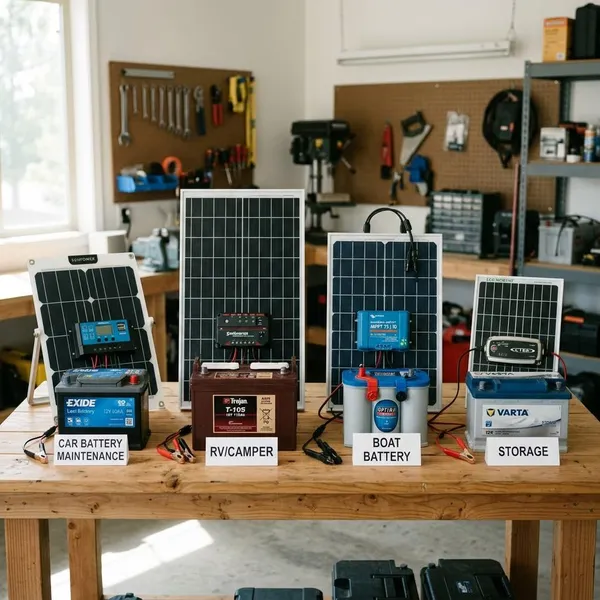
Best 12V solar battery charger options by use case
The best option changes once you think about where the battery lives. A dashboard panel for a car parked outside in summer is a very different setup from a roof-mounted panel on a trailer stored through winter. Pick for the situation, not just the highest advertised wattage.
Best charger for cars and long-term vehicle storage
For a car that sits for weeks, look for a 10W to 20W regulated solar maintainer with secure connectors and enough cable length to place the panel in real sun. A 5W panel may work for a healthy battery in bright conditions, but it leaves little margin if the car has alarm systems, keyless-entry electronics, or shaded parking.
- Driveway storage: an outside panel usually performs better than one behind glass.
- Garage window setup: choose more wattage because indirect light reduces output.
- Long-term vehicle storage: ring terminals or an SAE quick connector are easier than opening the hood repeatedly.
Best charger for motorcycles and small batteries
Motorcycles, scooters, ATVs, and lawn tractors usually need a low-output smart maintainer rather than a larger panel. A 5W to 10W regulated charger is often the safer choice because small batteries do not need aggressive charging. If you rotate one panel between several machines, SAE quick-connect leads make the setup far less annoying.
Best charger for RVs and trailers
RVs and trailers usually need a stronger kit because they may have propane detectors, control boards, stereo memory, and other standby loads. A small weekend trailer might manage with 20W to 30W for maintenance, while a larger RV or year-round storage setup often needs 50W or more.
Portable suitcase panels are useful when you want to aim the panel at the sun and avoid shade. Roof-mounted panels are more convenient for regular storage, but they need secure installation, weather-safe wiring, and a controller sized for the panel.
Can a 12V solar battery charger charge a dead battery?
A 12V solar battery charger can sometimes help a low battery, but it is not the best tool for a truly dead one. Small solar chargers are designed to prevent discharge and slowly replace lost energy, not rescue a battery that has dropped far below a normal voltage range.
Solar chargers work best for partially drained batteries
If the battery still has usable voltage and is otherwise healthy, a solar charger can slowly bring it up, especially with a 20W or 30W panel in strong sun. This is the realistic case: a car sat too long, the interior lights still work, and you are trying to recover some charge over a day or two rather than start the engine immediately.
Deeply discharged batteries may need a standard charger first
A deeply discharged battery may not wake up with a small solar maintainer. Some controllers will not start charging if they cannot detect a safe battery voltage, and a damaged battery may not accept charge properly at all.
Use a plug-in charger first if the battery is extremely low, then use solar for ongoing maintenance once the battery is back in a normal range. If the battery loses charge again quickly after recovery, replacement may be the more sensible fix.
Charging speed depends on sunlight and battery condition
Charging speed depends on panel wattage, sun angle, weather, temperature, cable loss, and the condition of the battery. A panel rated at 20W will not deliver 20W all day, and output through a windshield or in winter can be much lower. For planning, treat solar charging as slow maintenance unless you are using a larger panel in direct sun.
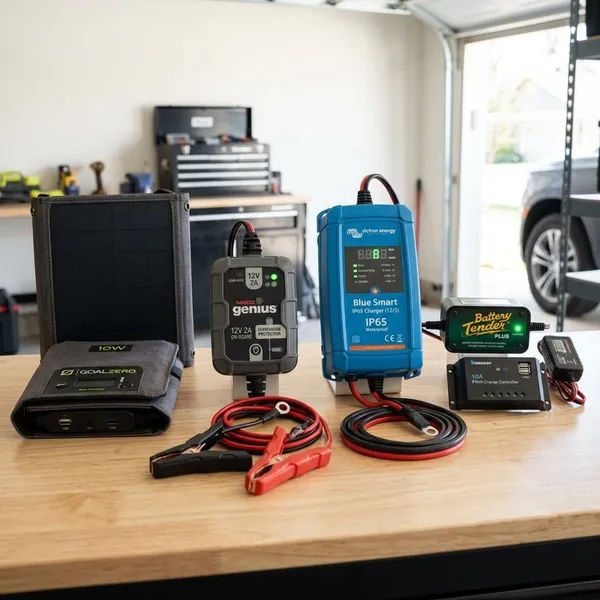
What features should a good 12V solar battery charger have?
A good 12V solar battery charger should be safe to leave connected, durable enough for where you will use it, and simple enough that you will actually keep it connected. The most useful features are not flashy: proper regulation, weather resistance, clear battery compatibility, and connectors that suit your setup.
Weather-resistant design improves outdoor reliability
If the panel will sit outside, look for weather-resistant construction, sealed wiring points, UV-resistant materials, and corrosion-resistant connectors. This matters most for boats, trailers, tractors, and vehicles stored outdoors all year, where rain, heat, vibration, and dust can slowly weaken cheap hardware.
Smart charging protects the battery from overcharging
Smart charging is important when the charger stays connected for days or months. A proper controller reduces charging as the battery fills and helps prevent overcharging in strong sun. For lithium batteries, do not rely on a general "12V compatible" claim; the controller should specifically support the lithium chemistry you use.
Useful connectors make installation easier
Connector choice affects whether the charger is convenient or a constant hassle. Alligator clips are fine for temporary use, ring terminals are better for long-term attachment, SAE quick-connects are practical for motorcycles and stored cars, and a 12V accessory plug only works if that outlet stays live when the vehicle is off.
- Temporary charging: alligator clips are quick but less tidy.
- Seasonal storage: ring terminals are more secure.
- Frequent connect/disconnect: SAE leads save time.
- Dashboard panel: confirm the 12V socket is not switched off with the ignition.
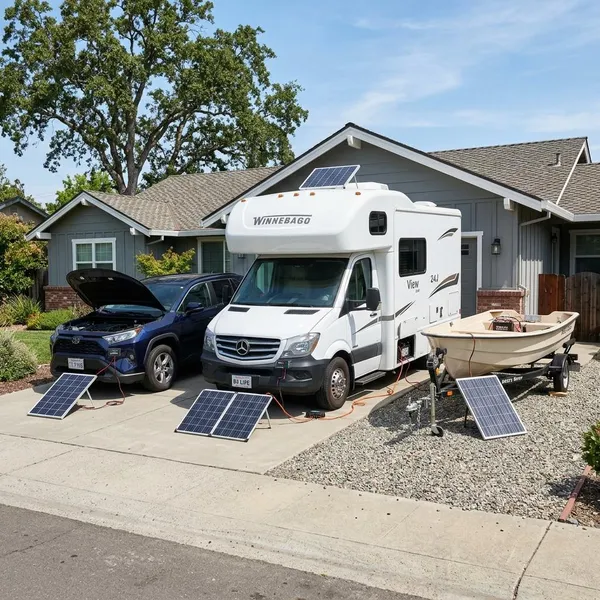
Is a 12V solar battery charger worth buying?
A 12V solar battery charger is worth buying if your battery sits unused and you have reliable access to sunlight. It is less useful if the vehicle is parked in deep shade, the battery is already failing, or you need fast charging after heavy use.
It keeps stored vehicles ready to use
The biggest benefit is simple readiness. A collector car parked for a month, a motorcycle stored through winter, or a boat between weekend trips can lose enough charge to become inconvenient. A solar maintainer helps reduce that slow drain so the battery is more likely to be ready when you need it.
It reduces battery maintenance and replacement costs
Keeping a lead-acid battery from sitting partly discharged can reduce avoidable wear, especially during long storage periods. A solar charger will not make an old battery new, but it can help you avoid the cycle of neglect, deep discharge, emergency charging, and early replacement.
It cannot replace a full charger for heavy charging needs
A solar maintainer is not a replacement for a plug-in charger, jump starter, or larger off-grid charging system. If you regularly drain a battery deeply, need predictable charging overnight, or run larger electrical loads, keep a standard charger available and use solar as the low-effort maintenance layer.
Conclusion
Choose the charger that fits the way your battery actually sits: small and regulated for a stored car or motorcycle, stronger and better controlled for an RV, trailer, or boat. If the battery is healthy and sunlight is available, a solar maintainer can be a smart way to prevent dead-battery surprises; if you need fast recovery or heavy charging, pair it with a proper plug-in charger instead.